Sonos Beam (Gen 2): Still Good, but Stretch to the Ultra If You Can
What the Beam (Gen 2) does well at $799, why the $1,099 Beam Ultra is worth the stretch, and the rooms where the older Beam still makes sense.

The Sonos Beam is the soundbar most people picture when they think of Sonos: compact enough for a mid-size TV, one cable to plug in, and good enough with dialogue and music that it replaces a TV’s thin built-in speakers for good. In September 2026 Sonos put the Beam Ultra above it, and kept the Beam (Gen 2) on sale underneath.
The Gen 2 is still a good soundbar, and at $799 you’ll be happy with it. But if the budget can stretch the extra $300 to the Beam Ultra, do it: the Ultra adds real Dolby Atmos height and a clearer centre channel, and it’s the better bar for the main TV in a living room. The Gen 2 makes most sense where it isn’t the centrepiece, in a bedroom, rumpus room or smaller lounge, or where the Ultra won’t physically fit. If you’re still choosing across the range, start with the best Sonos speakers.
What the Beam (Gen 2) does
The Beam connects to the TV with a single HDMI cable to the TV’s eARC or ARC port, so the TV remote controls the volume and the Beam switches on with the TV. An optical adapter comes in the box for older TVs without HDMI ARC, but over optical you lose Dolby Atmos and control from the TV remote, so HDMI is the way to go if the TV has it. Sonos lists which connections suit which TVs if you’re unsure.
Inside its 651 mm-wide body are five amplifiers driving a centre tweeter and four elliptical midwoofers, plus three passive radiators for bass. Two settings in the Sonos app help with dialogue: Speech Enhancement lifts voices over the soundtrack, and Night Sound narrows the gap between quiet and loud scenes so you can keep the volume down without losing the conversation. Trueplay tunes the sound to the room using an iPhone or iPad.
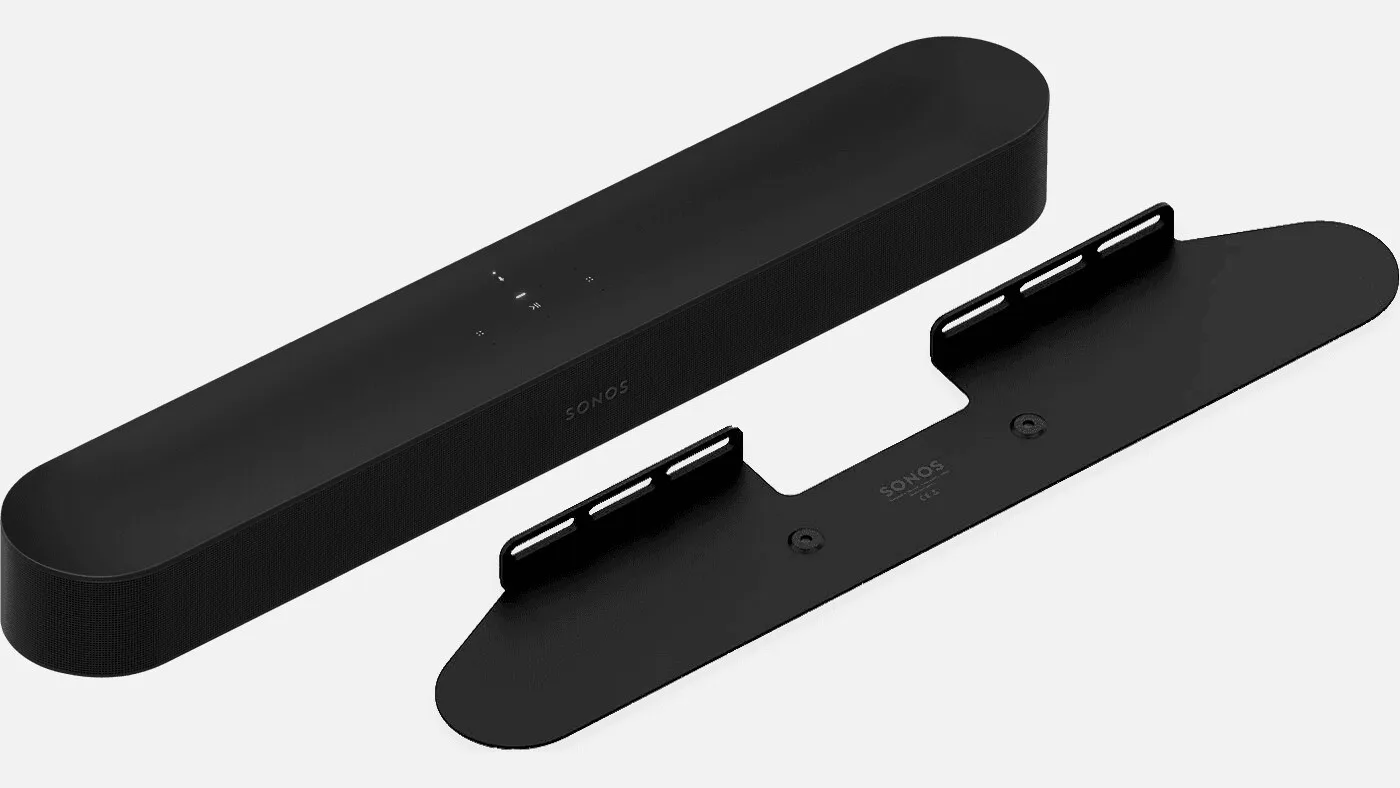
The Beam (Gen 2) in black with its wall mount. Image: Sonos
It’s a full Sonos speaker for music too, with AirPlay 2 from Apple devices and an Ethernet port if your Wi-Fi is patchy. That’s worth knowing because the Beam only uses 2.4 GHz Wi-Fi, so a router set to 5 GHz only needs the 2.4 GHz band switched on or a cable run to it. Microphones built into the Beam support Amazon Alexa or Google Assistant, one at a time; Sonos’s own voice control isn’t offered in Australia. It comes in black or white, and the full specs are on Sonos’s Beam page.
How it does Dolby Atmos without up-firing speakers
Dolby Atmos adds height to a film’s soundtrack, with rain and helicopters placed above you rather than just around you. Soundbars that do it properly have speakers angled at the ceiling, which bounce sound down to the listener. The Beam (Gen 2) has none. Sonos uses processing to create what it calls phantom height channels from the drivers facing forward.
It plays Atmos from Dolby Digital Plus, the format streaming services use, and from Dolby TrueHD off a Blu-ray player. Sonos says TrueHD needs an eARC port, so eARC is the connection to have, though Atmos from streaming apps can also come through an older ARC port.
Virtual height is better than none, but it’s the clearest gap between this Beam and the Ultra.
Why the Beam Ultra is worth the extra $300
The Beam Ultra went on sale on 29 September 2026 at $1,099. For the extra $300 it has nine amplifiers driving five tweeters, two of them firing upward, and four woofers, which gives it real Atmos height in a 7.1.2 layout rather than an imitation of it. It also has a redesigned centre channel and four levels of AI Speech Enhancement, so dialogue is better handled too, not just the effects.
For the main TV in a living room or a dedicated home theatre, that’s the better use of the money. A soundbar in the room where you watch most films is something you live with for years, and the Ultra fixes the one real weakness of the Gen 2.
Where the Beam (Gen 2) still makes sense
The Gen 2 is the better buy when the soundbar isn’t the main event. In a bedroom, rumpus room or smaller lounge, it’s a big step up from the TV’s speakers, and the Ultra’s height effects matter less in a room you don’t watch many films in.
It’s also the one that fits more places. The Ultra’s up-firing tweeters need about 10 cm clear above the bar, so under a low shelf it falls back to simulated height, which is what the Gen 2 already does for less. The Ultra is also about 10 cm wider at 750 mm against 651 mm, so measure the TV cabinet first. And for an older TV with optical only, the Gen 2 includes the optical adapter that the Ultra sells separately.
Beam (Gen 2) or Ray
The Ray is the cheapest way into Sonos TV sound at $349, and the step down from the Beam is a big one. It connects by optical only, with no HDMI, so there’s no Dolby Atmos and none of the HDMI control that lets the Beam switch on and change volume with the TV. It has no microphones, so no built-in voice assistant. At 557 mm wide it’s smaller than the Beam, with two tweeters and two midwoofers.
For a bedroom TV where you just want clearer sound, the Ray does the job. If you want HDMI and fuller sound in that second room, the Beam (Gen 2) is worth the extra $450.
Adding bass and rear speakers
If you’re tempted to buy the Beam (Gen 2) and put the savings towards a Sub Mini ($699), buy the Beam Ultra instead. At RRP the Ultra on its own costs $1,099, against $1,498 for the Gen 2 and Sub Mini together, and it fixes the height problem a subwoofer doesn’t touch. You can add a Sub Mini and rear speakers to the Ultra later, as the budget allows.
If you already have a Beam (Gen 2), or it’s the right bar for a second room, it builds out the same way. The Sub Mini pairs with it for deeper bass, and For rears, a pair of Era 100 SLs ($289 each) is the best match, or a pair of Plays ($499 each) if you’d use them around the house too. Era 300s ($799 each) also work, but a pair costs more than the step up to a Beam Ultra, which is the better place for the money.
Previous models: Beam (Gen 1)
The original Beam went on sale in July 2018 at US$399. It looks almost the same, at the same size, but it connects by HDMI ARC rather than eARC and doesn’t support Dolby Atmos. The Gen 2 added Atmos, eARC, more processing power, new speaker arrays and an updated perforated grille.
Sonos no longer sells the Gen 1 new in Australia, though it still works with the current Sonos app. Second-hand, it’s a cheap way to get much better TV sound in a bedroom or second room, as long as you don’t need Atmos.