Tudor Black Bay Pro: The Expedition Watch, Tudor's Way
Why a watch for caves and polar summers needs a 24-hour hand, how the Pro turns the Black Bay GMT into a plainer tool watch, and how it compares with the Explorer II.
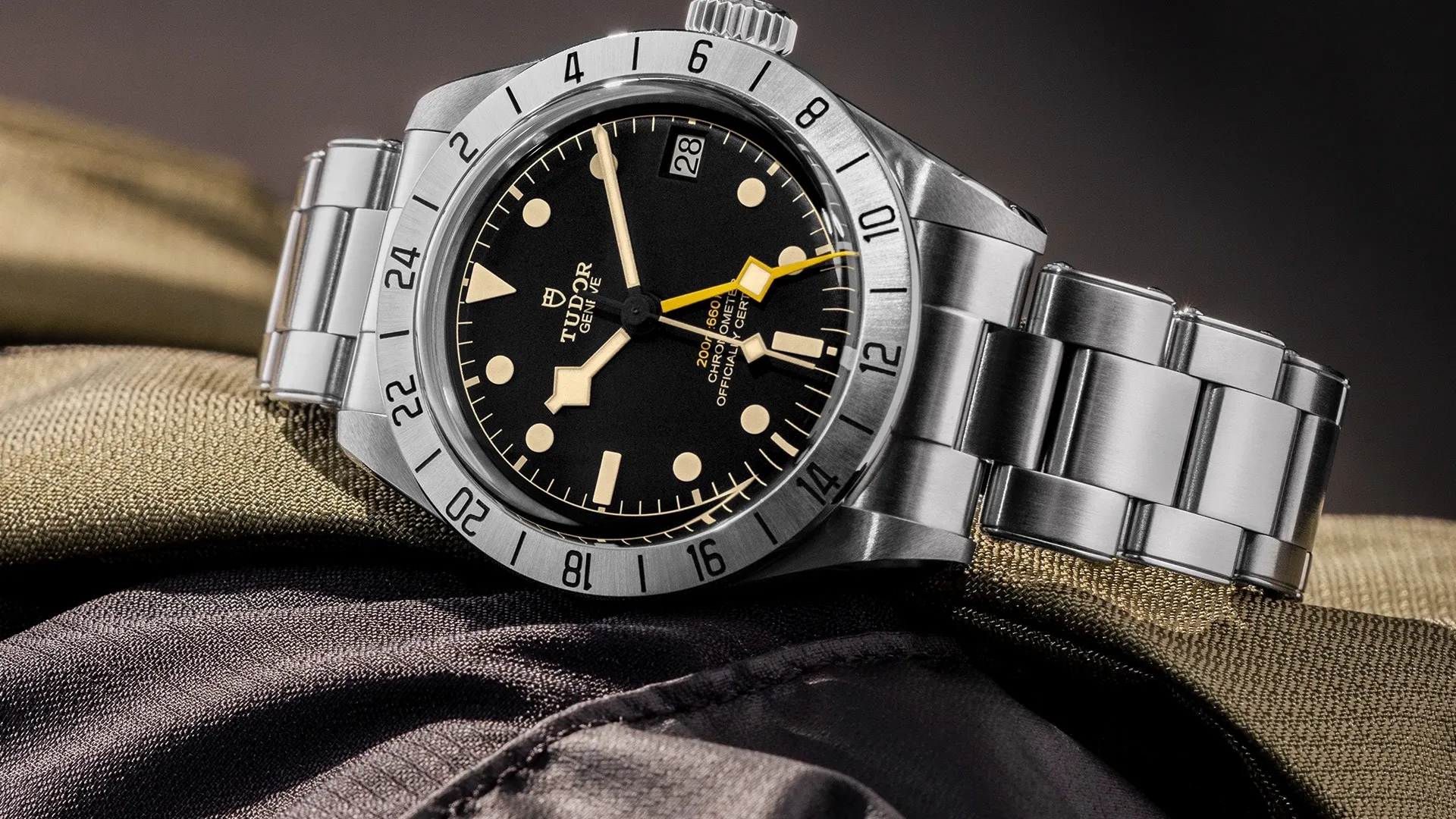
You’ve probably heard the Black Bay Pro called “the affordable Explorer II”, and there’s something in it. Like Rolex’s expedition watch, it has a fixed steel bezel marked in 24 hours and a bright extra hand that goes round it once a day, a layout made for people who can’t see the sun. Tudor builds it on the jumping-hour movement from its Black Bay GMT, in a plainer 39mm steel case.
It costs $6,660 on a strap and $7,180 on the bracelet, well under half the $17,750 Rolex asks for a current Explorer II. It sits in our guide to the best Tudor watches.
Why an explorer needs a 24-hour hand
On an ordinary watch, 7 o’clock looks the same morning and night. That doesn’t matter while you can see daylight. Deep in a cave, or in a polar summer where the sun never sets, it matters a lot, and that’s the problem Rolex set out to solve with the Explorer II. As Rolex tells it, the watch added an orange hand that goes round once every 24 hours against a fixed bezel graduated to 24, so a glance tells you whether it’s 7am or 7pm. It also showed the date, for when the days blur together.
It became the watch of cavers, volcanologists and polar explorers. The volcanologist Haroun Tazieff wore his over a thermal suit on Mount Etna in 1971. Later Explorer IIs let the hour hand be set on its own, independently of the 24-hour hand, which turned a day-and-night indicator into a second time zone.
Tudor itself never mentions the Explorer II. Its story for the Pro goes back to its own expedition watches: the Oyster Princes that Hans Wilsdorf, who founded both Rolex and Tudor, supplied to the 1952 British North Greenland Expedition. Tudor calls the Pro “a tool-watch designed for professional use”, fit for exploration “whether polar or subterranean”. Reviewers drew the line to Rolex anyway. Fratello reads it as a nod to the early-1970s Explorer II, reference 1655, and it’s hard to look at the two side by side and disagree.
Why the Black Bay Pro looks the way it does
The Pro arrived in 2022. Tudor’s brief was to take the heritage-styled Black Bay and tweak it to a professional standard, and most of the changes serve that.
The bezel is the big one. On the Black Bay GMT it rotates and carries a two-tone insert. On the Pro it’s solid satin-brushed steel, engraved to 24 and fixed in place. There’s nothing to knock out of position on a rock face and nothing to set. The trade-off is that a fixed scale can only ever read one extra time zone: whatever the yellow hand is set to.
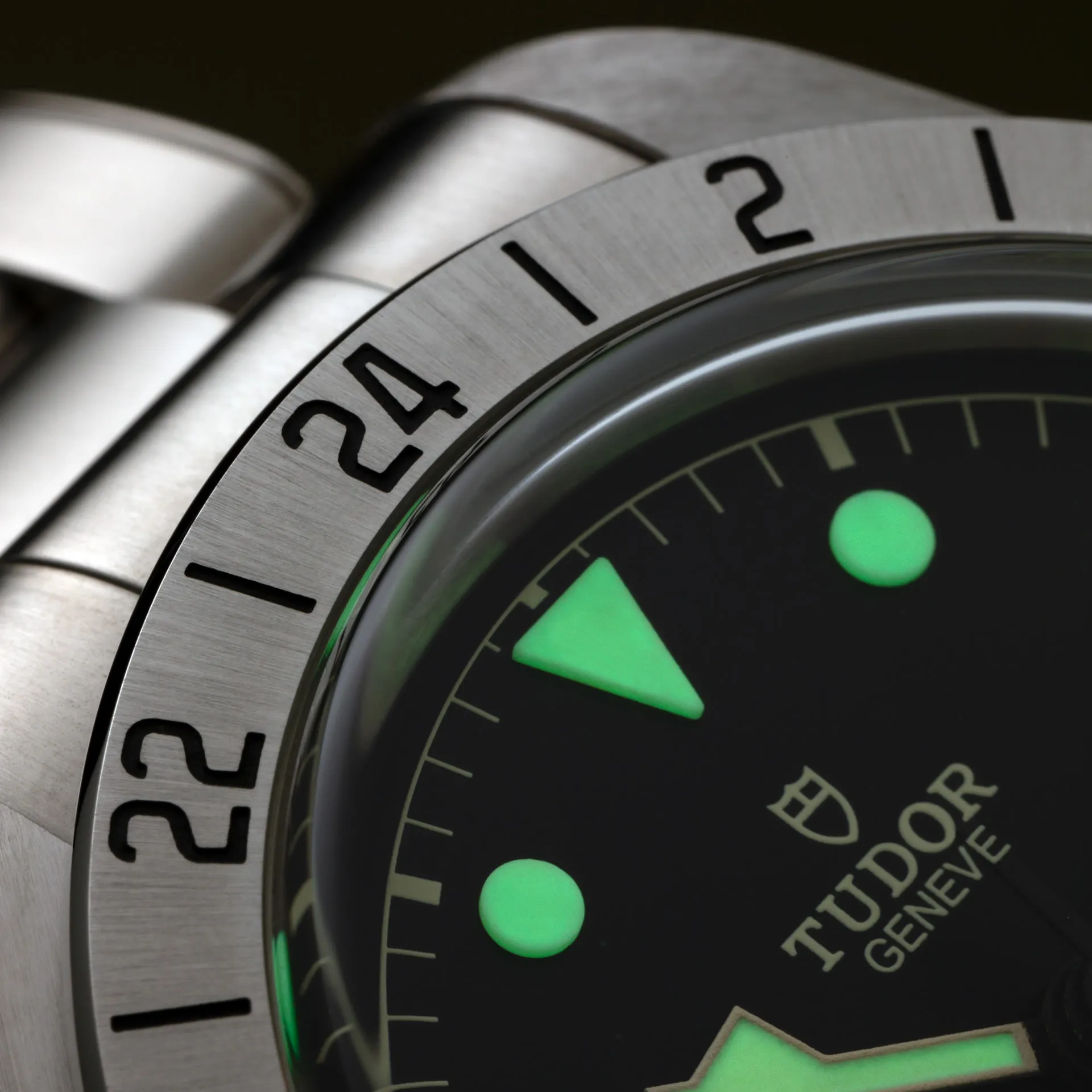
The fixed steel 24-hour bezel and the luminous markers up close. Image: Tudor
That yellow hand is a snowflake, the shape Tudor has put on its dive watches since 1969, and the hour hand is a shorter snowflake to match. The hour markers are ceramic, filled with Super-LumiNova, so they read clearly in the dark that the watch is built for. The crown was reshaped for grip and sits flush with the case, so the tube it screws onto is out of sight.
The case is 39mm across, smaller than the 41mm Black Bay GMT, but it isn’t slim. Fratello puts it at 14.6mm thick, the same as the bigger GMT, because it holds the same movement. Tudor doesn’t publish a thickness.
In 2025 Tudor added an opaline dial, a creamy white, with the hands and markers outlined in black so they stand out. White is also the dial Rolex uses on the current Explorer II.
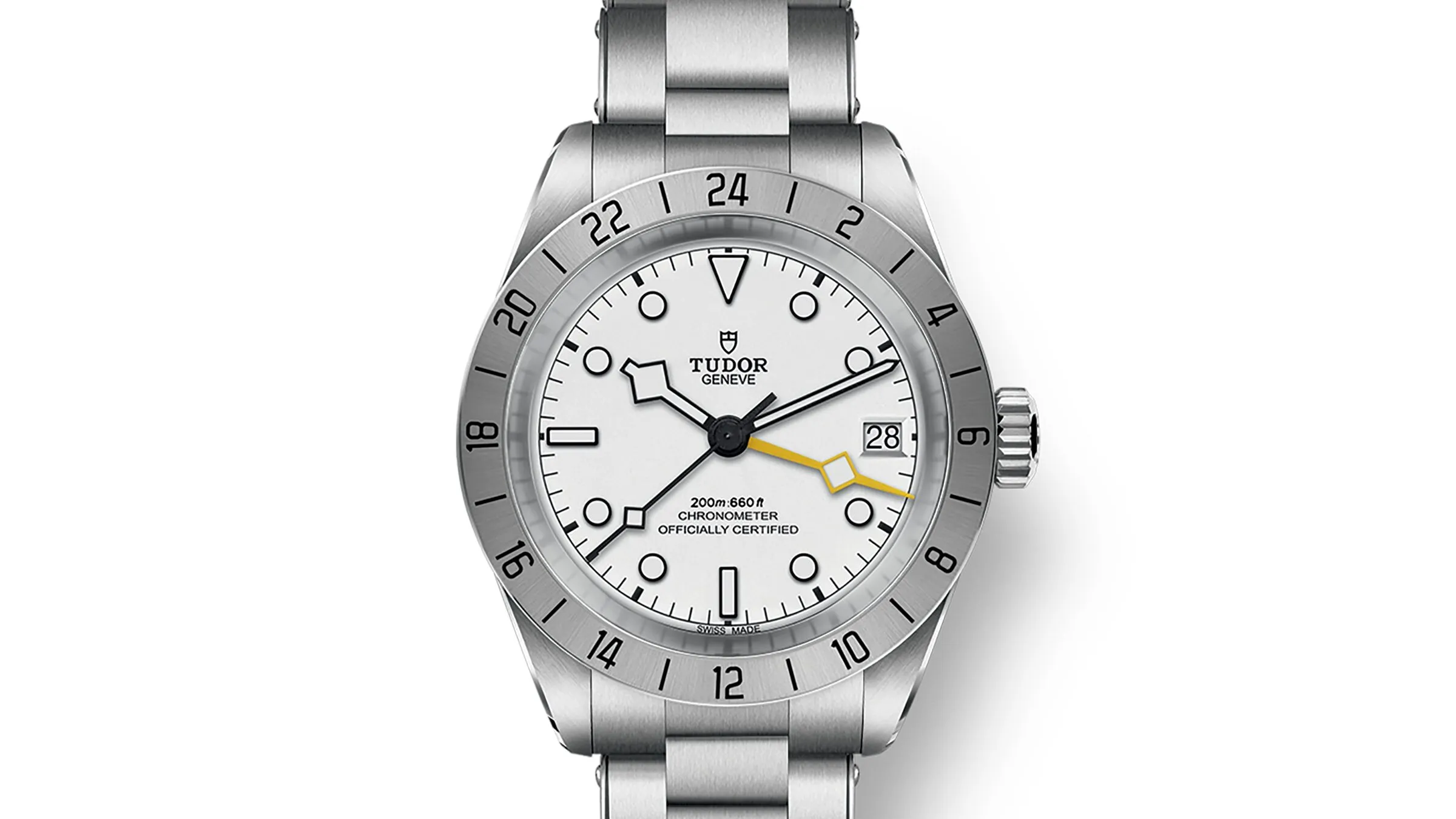
The opaline dial version, reference M79470-0004. Image: Tudor
The jumping hour
Inside is the MT5652, the movement Tudor first put in the Black Bay GMT in 2018. When you land somewhere new, you pull the crown out and the local hour hand jumps forwards or backwards an hour at a time, while the yellow hand stays on home time and the watch keeps running. The date follows the hour hand, backwards too, so going back across midnight takes the date back a day. Our Black Bay GMT story explains why that “flyer” layout suits travellers better than the alternative.
The movement is COSC-certified, has a silicon balance spring that resists magnetism and runs for about 70 hours, so it’s still going on Monday if you take it off on Friday night. The case is water resistant to 200 metres.
Black Bay Pro or Black Bay GMT?
These are the same watch underneath, so the choice comes down to the bezel, the size and the look.
The Black Bay GMT’s rotating bezel can track a third time zone: set the yellow hand to home, turn the bezel to read somewhere else. Its two-tone insert, burgundy and blue, is the classic travel-watch look. The Pro gives that up for a fixed scale that’s always right and a plainer, all-steel face. It’s also 2mm smaller across, and a little cheaper: $6,660 to $7,180 against $6,910 to $7,430 for the steel Black Bay GMT.
If you want one home time at a glance in a tougher-looking watch, get the Pro. If you fly often and juggle more than two zones, the Black Bay GMT does more. And if you want a rotating bezel in a slimmer case, the 39mm Black Bay 58 GMT is 12.8mm thick by Fratello’s measure and costs $7,440 to $7,950. It’s the GMT version of the 39mm Black Bay 58 dive watch.
Price and how it compares
There are six versions: a black or opaline dial, each on three choices of bracelet or strap. The riveted steel bracelet costs $7,180 and closes with Tudor’s T-fit clasp, which adjusts by 8mm in five steps without tools. A black fabric strap with a yellow stripe, woven in France by Julien Faure, or a hybrid rubber and leather strap, costs $6,660. Every Tudor comes with a five-year transferable guarantee.
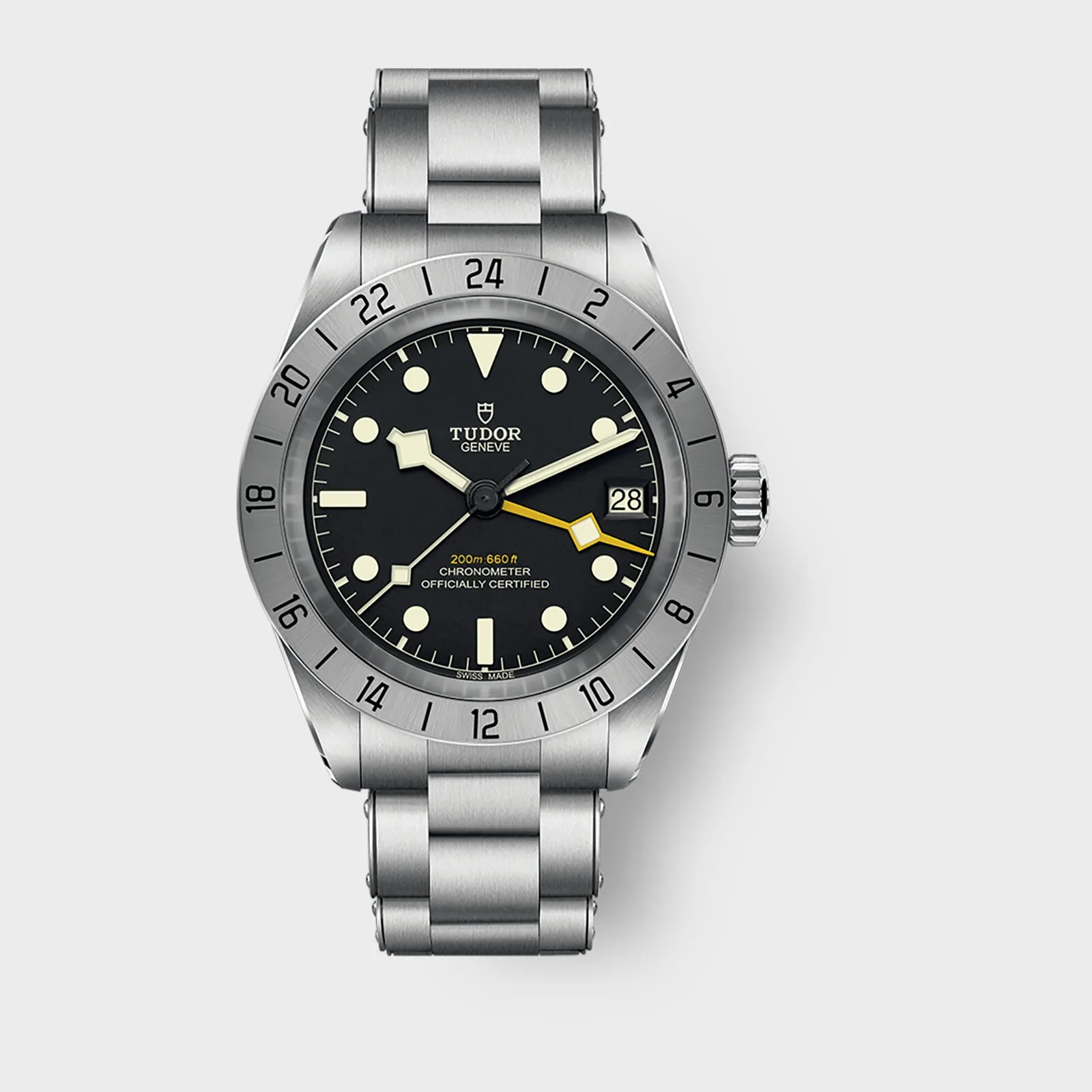
The Black Bay Pro in black on the riveted steel bracelet. Image: Tudor
The current Rolex Explorer II, reference 226570, is a 42mm Oystersteel watch with a white dial and an orange 24-hour hand, at $17,750. That’s $10,570 more than the Pro on a bracelet. For that you get a bigger case, Rolex’s own movement and the name on the dial that started the idea. The Pro gives you the same way of reading the day, in a smaller case, for well under half the price.
Tudor’s retailer locator on its website lists the boutiques and authorised dealers around Australia.