Tudor Black Bay 58: The Dive Watch for Everyone
From the 1958 Big Crown to the thinner, Master Chronometer edition of 2026: where each detail comes from, how it compares with the Black Bay 54 and 41, and what it costs in Australia.
In 1958 Tudor released the reference 7924, a dive watch rated to 200 metres with a winding crown so large that collectors still call it the “Big Crown”. It was Tudor’s second diver, four years after the reference 7922 of 1954, and it did what Hans Wilsdorf had set Tudor up to do: give buyers Rolex’s dependability at a price his agents could sell more easily.
The Black Bay 58 is Tudor’s modern take on the divers of that era, and nearly every detail on it can be traced back to them: the 39mm case, the matt domed dial, the rotating bezel, the riveted-look bracelet and the 200-metre rating. It arrived in 2018 as a smaller alternative to the 41mm Black Bay. The 2026 edition goes further, with a thinner 11.7mm case and Master Chronometer certification, from $6,990. It’s the pick in our guide to the best Tudor watches.
Tudor’s first divers, 1954 to 1959
Tudor’s first dive watch, the reference 7922, was called the Oyster Prince Submariner. It had a 37mm case and was rated to 100 metres. Like other early Tudors, it shared plenty with Rolex: its riveted steel bracelet was signed Rolex.
Four years later, the 7924 doubled the depth rating to 200 metres. To get there, Tudor made the 37mm case thicker and fitted a larger screw-down crown, 8mm across against the 7922’s 5mm, which gave the watch its nickname. It also had a thicker, domed acrylic crystal to stand up to the pressure, and a black lacquered dial marked “200 m = 660 ft”.
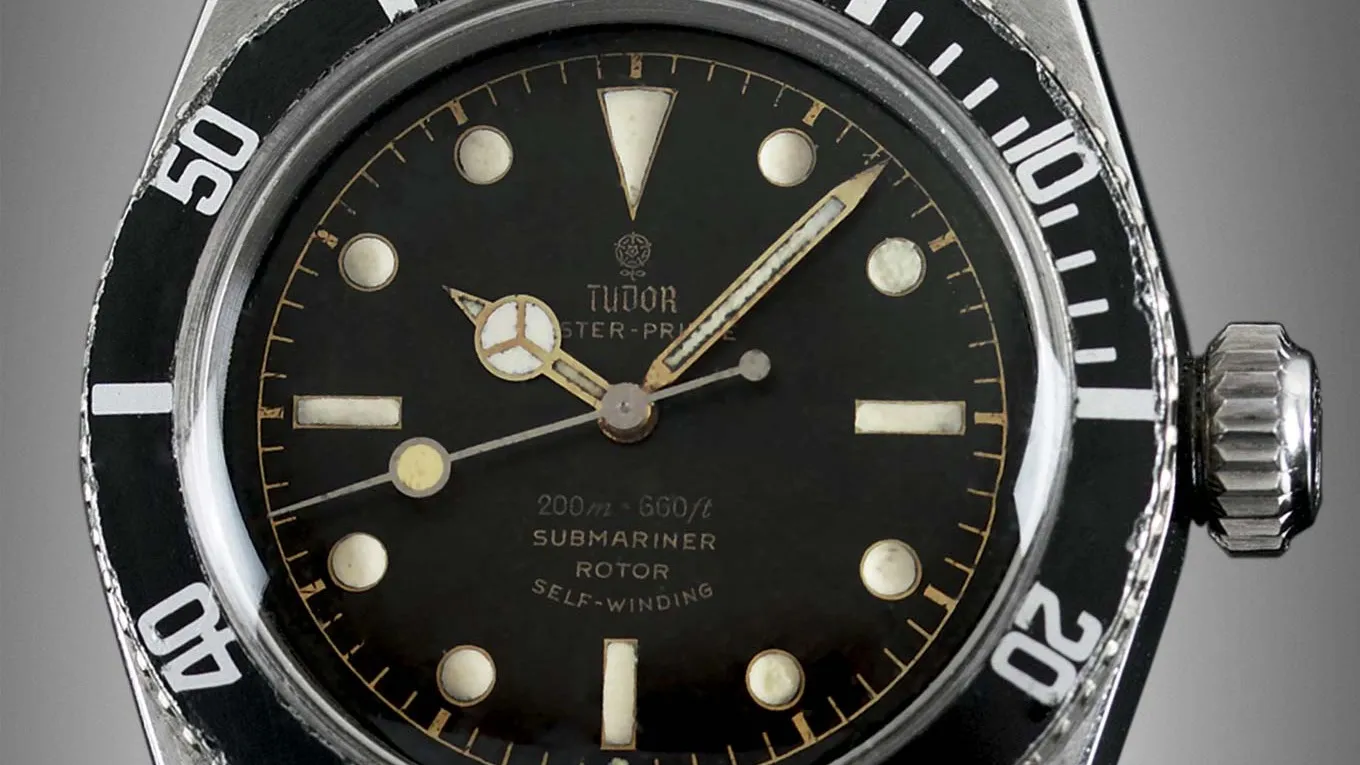
The reference 7924 “Big Crown” of 1958, named for its 8mm winding crown. Image: Tudor
The next year brought the reference 7928, and with it two things the Black Bay 58 still carries. Its case grew to 39mm and gained crown guards, and its dial text was printed in gilt. The Black Bay 58 takes its name from the 7924, but its size comes from the 7928.
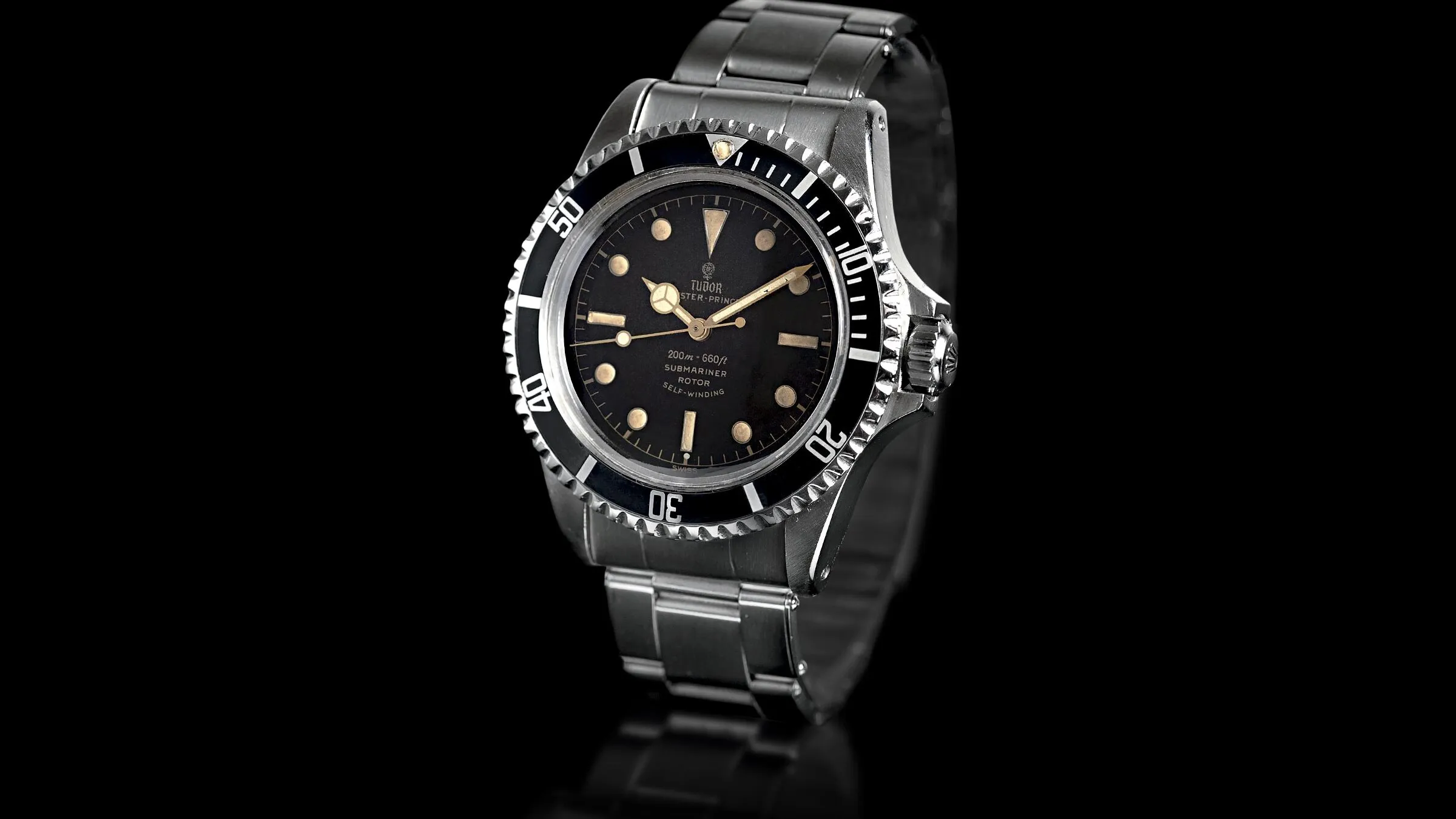
The reference 7928 of 1959, the first Tudor diver with crown guards. Image: Tudor
Tudor’s own page for the Black Bay 58 925 draws that line, saying the name refers to 1958 and the 7924. Across the range, Tudor calls it “a tribute to the 1950s Tudor divers’ watches”.
Why it looks the way it does
Most of the Black Bay 58’s details started as solutions to a diver’s problem, and survive because they still look right.
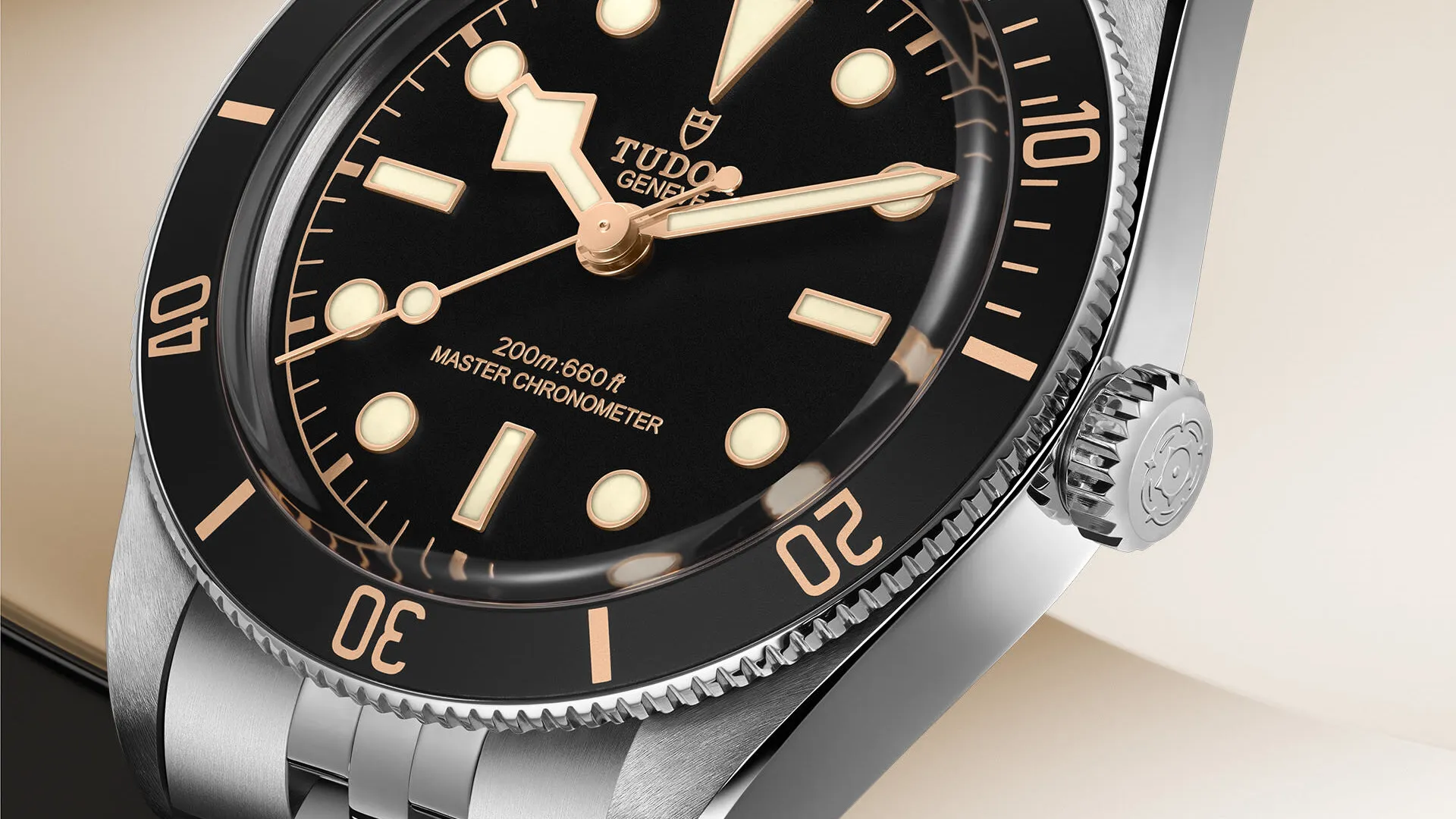
The 39mm case is the 7928’s size, and it’s why the Black Bay 58 fits so many wrists. The 200-metre rating, the screw-down crown and the timing bezel are the kit a 1950s diver needed to stay dry and know when to come up. Tudor has made the new bezel deliberately harder to turn when its triangle sits at 12, so a knock doesn’t nudge it off zero.
The dial is matt and domed, which Tudor says is “just like the early TUDOR diving watches”, and the gilt print recalls the 7928’s gilt lettering. On the steel 2026 model, the hands are pinched at the base.
The silver and bronze editions keep the angular hands collectors call “Snowflake”. Those came later, in 1969, when Tudor’s reference 7016 introduced angular hands and square markers that could hold more luminous paint, which mattered to the French Navy divers who wore them.
The bracelet is a nod too. Tudor says the three-link “rivet-style” bracelet refers to its riveted bracelets of the 1950s and 60s, with the rivet heads visible on the side of each link. They’re decorative now, but the look is the 7922’s.
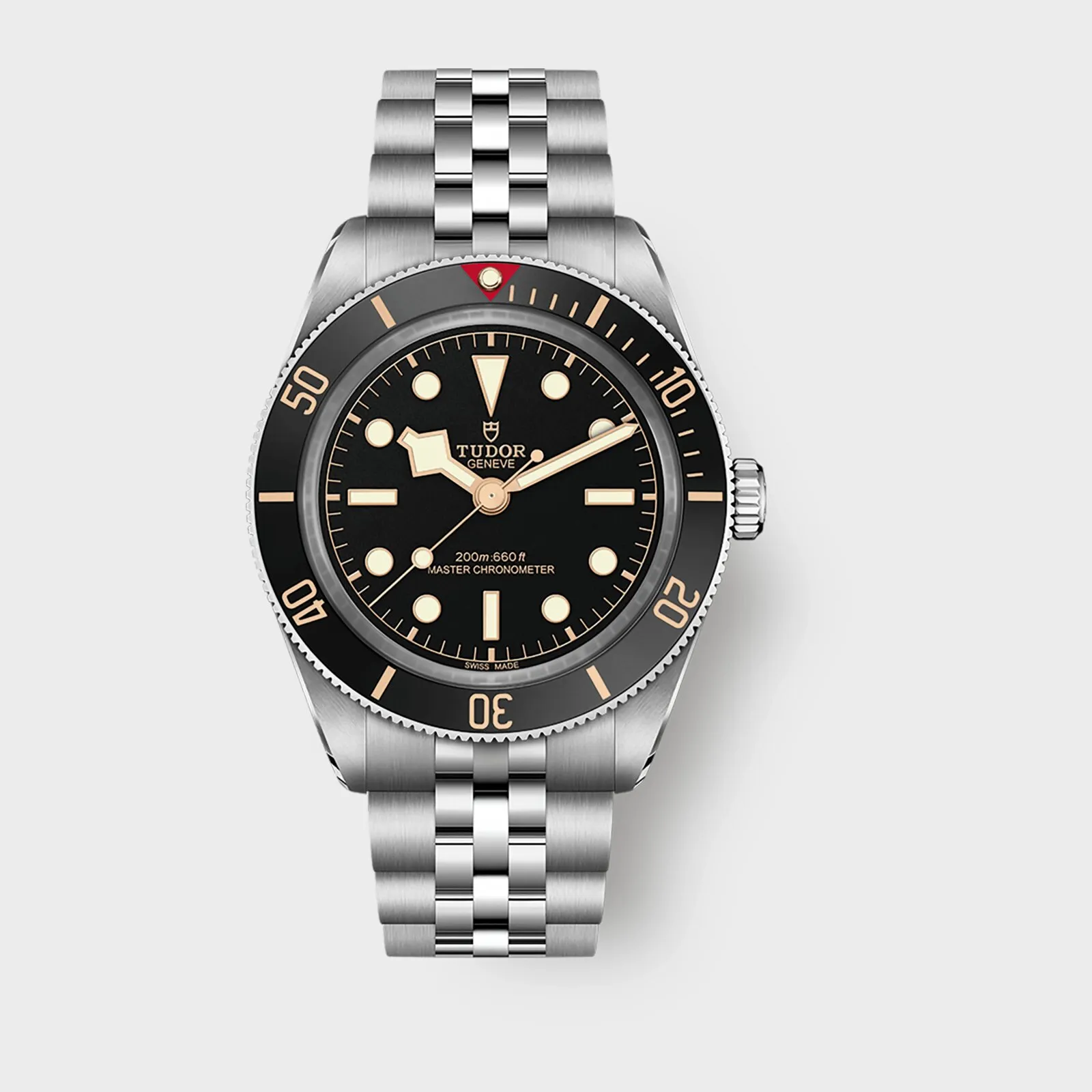
The Black Bay 58 with a black dial on the rivet-style bracelet. Image: Tudor
The 2018 original and the 2026 edition
Reviews at the time from aBlogtoWatch and Monochrome set out what the 2018 original changed. Tudor’s main Black Bay diver was 41mm across with 22mm lugs; the 58 came in at 39mm with 20mm lugs, and with a new movement, the MT5402, made for the smaller case, with 70 hours of power reserve. It came in black, then blue.
The 2026 new edition keeps the 39mm diameter and the look, and refines almost everything else. The case is a new shape, 11.7mm thick, against 11.9mm to 12.7mm for the older-case versions Tudor still sells. The bezel and crown are reshaped to match, with grippier bezel edges and a crown that sits flush with the case side. Tudor has cut the dial text to two lines.
Inside is the MT5400-U, with a 65-hour power reserve. It’s certified by COSC, the Swiss chronometer test, and by METAS, the Swiss federal metrology institute, which tests the finished watch rather than the bare movement. That makes it a Master Chronometer. The trade-off is a slightly shorter reserve, 65 hours against about 70, though take it off on Friday night and it’s still running on Monday morning either way.
Every version now comes with Tudor’s T-fit clasp, including the rubber strap, so you can loosen the bracelet without tools when your wrist swells on a hot day.
The blue Black Bay 58 is gone. Tudor no longer lists any of the original steel models, so a blue one now means the second-hand market.
Burgundy, silver and bronze
The new edition comes in black or burgundy. Black is the classic. Burgundy has its own story: Tudor says it draws on a Submariner prototype from the 1990s, ref 79190, with a burgundy dial and matching bezel that never went into production.
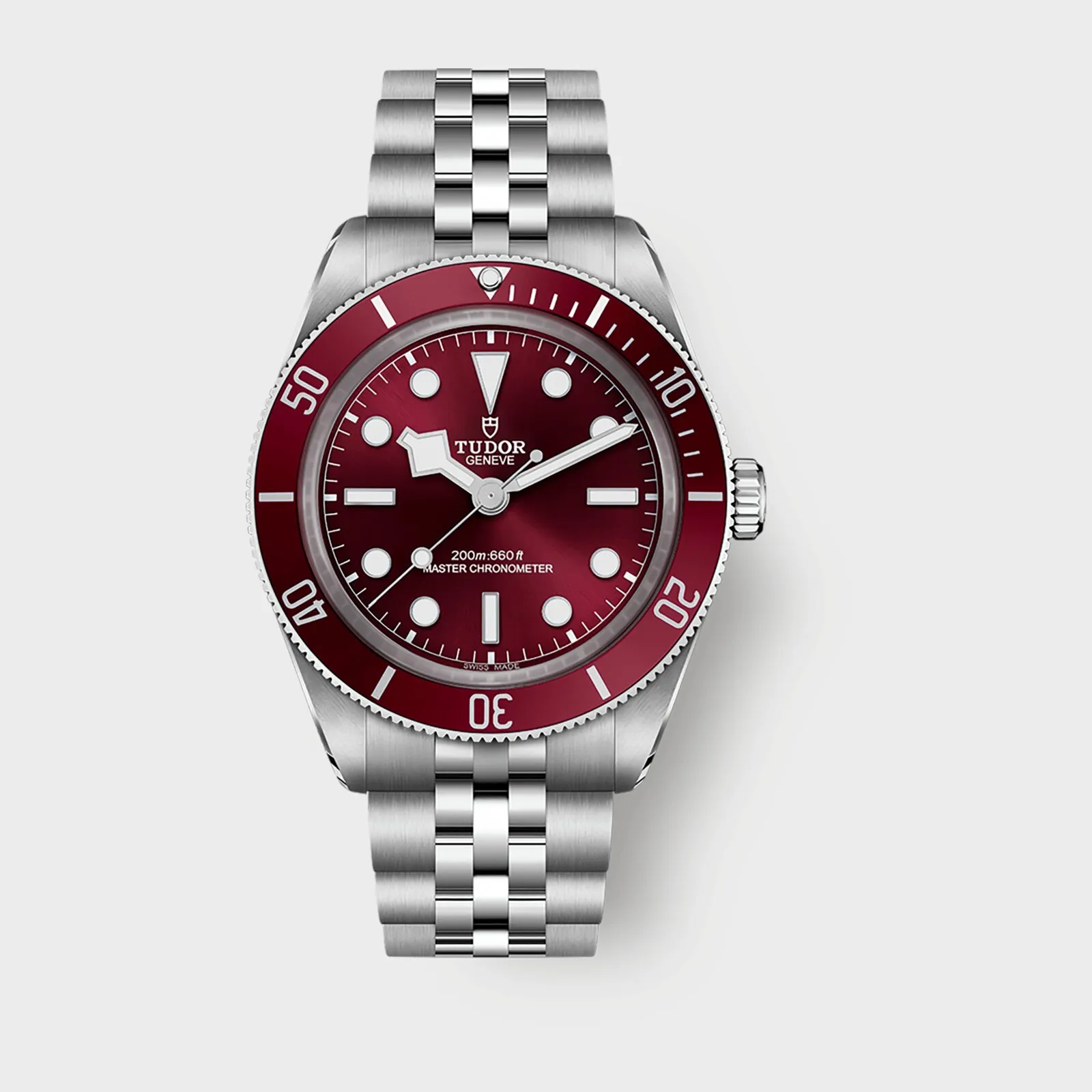
The Black Bay 58 with a burgundy dial. Image: Tudor
Tudor also sells the Black Bay 58 in three other metals. These use the older case and movement: the MT5400, with about 70 hours of reserve and COSC certification but not METAS.
The Black Bay 58 925 has a sterling silver case, which gives it half its name; the other half is 1958. Its taupe dial and brown leather strap make it the most relaxed version, better with a sports jacket than a suit. It’s also the thickest at 12.7mm.
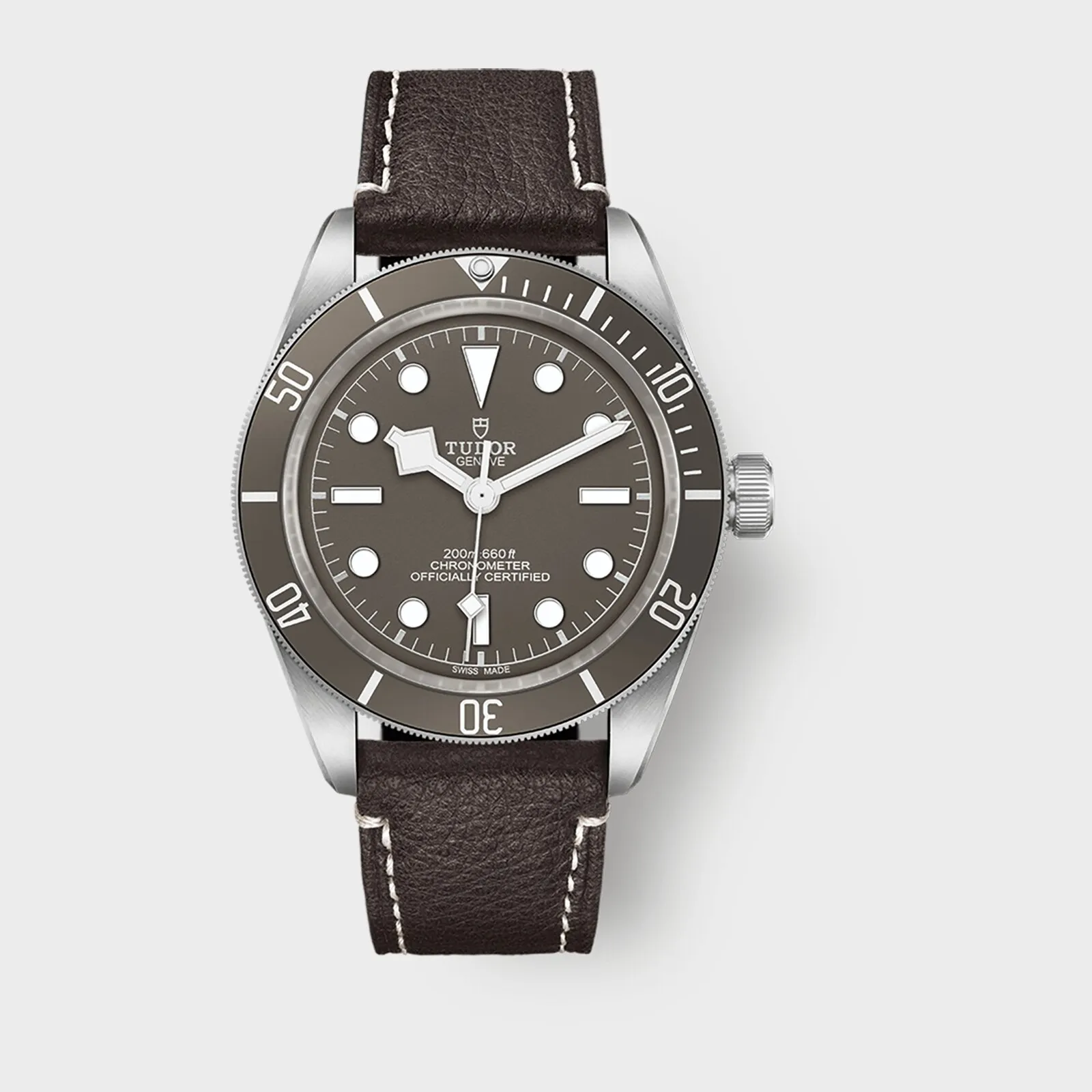
The Black Bay 58 925, in silver with a taupe dial. Image: Tudor
The Black Bay 58 Bronze is Tudor’s nod to the bronze fittings on old ships and diving equipment. The case darkens and changes colour as you wear it, so no two age the same way. It comes with a bronze bracelet and a woven strap that recalls one in Tudor’s archive: for decades the French Navy took its Tudors without bracelets and fitted its own, and one of those straps was made from the elastic of a rescue parachute.
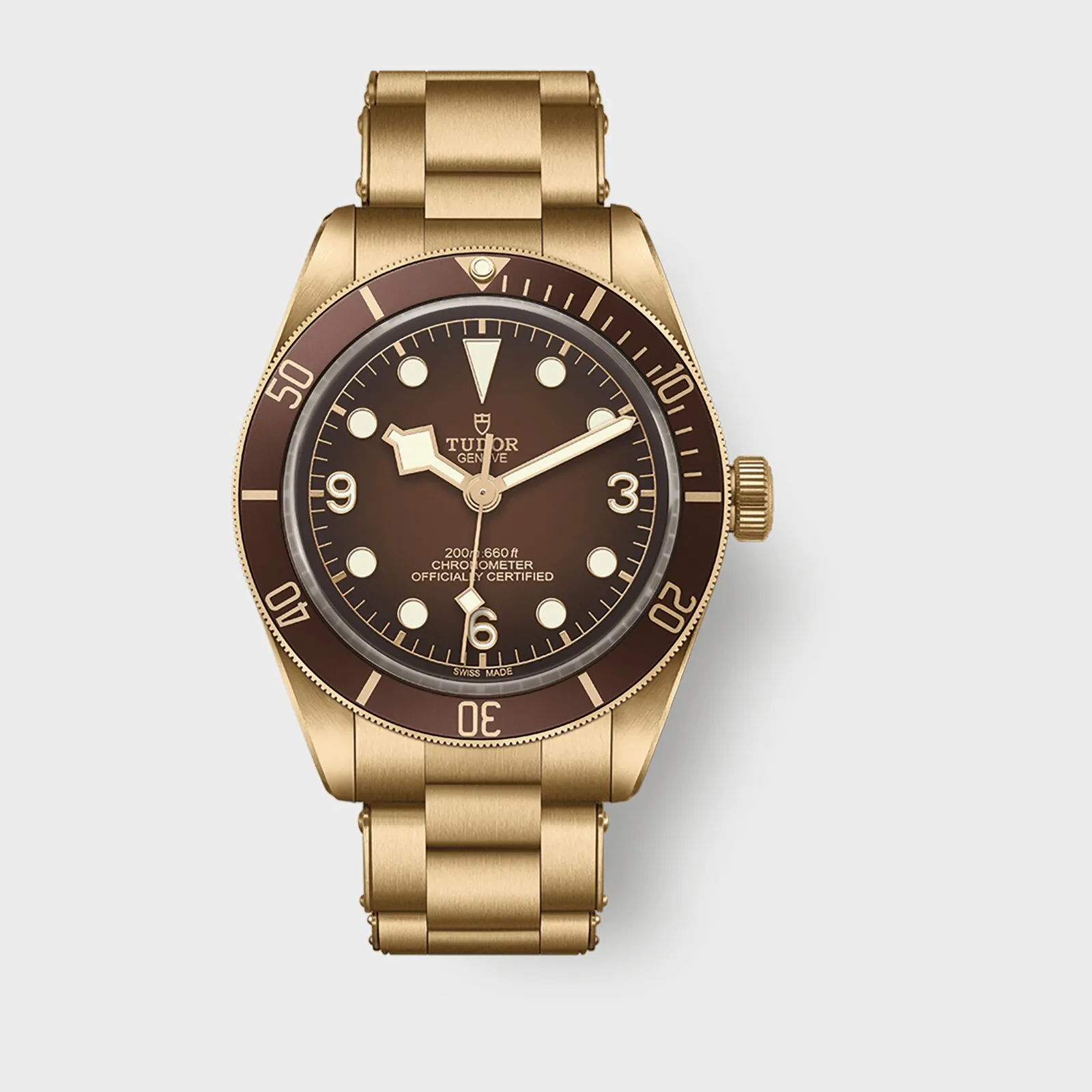
The Black Bay 58 Bronze. Image: Tudor
The 18K yellow gold version has a green dial. At $31,750 on a strap, it’s a different kind of purchase from the rest of the range.
How it wears
The Black Bay 58’s appeal comes down to size. Many dive watches are 41mm or more across and over 13mm thick, which looks right on a large wrist and like a hockey puck on an average one. At 39mm across and 11.7mm thick, the Black Bay 58 sits within the width of most wrists rather than overhanging them, and slides under a shirt cuff.
The Black Bay 54 is smaller again at 37mm, the 7922’s size, and 11.2mm thick. It suits a slim wrist or someone who wants the earliest proportions. The Black Bay 41 is 13.6mm thick, nearly 2mm more than the 58, and that thickness is what stops it sliding under a cuff.
The 1950s details are what let it dress up. The domed crystal and matt dial keep it from looking like a tool, the gilt softens the black, and the 20mm lugs take a leather strap well. It’s still a 200m dive watch, so it handles the beach and the pool without a second thought.
Tudor, Rolex and what you get for $7,000
Tudor and Rolex share a founder. Hans Wilsdorf, who founded Rolex, had the Tudor name registered in 1926 and set it up as its own company, Montres Tudor S.A., in 1946. Tudor tells that history on its own site.
The early divers wore Rolex-signed bracelets. The Black Bay 58 is its own watch: its movement is Tudor’s, made at Kenissi, the movement facility Tudor founded in 2016.
The price gap is the case for it. A Rolex Submariner without a date lists at $16,850. Omega’s Seamaster Diver 300M, the other obvious rival, starts at $9,925 and is 42mm across. The Black Bay 58 is smaller than both and thousands cheaper, and Tudor backs it with a five-year guarantee that transfers to a second owner, with no registration or service schedule needed to keep it.
Prices and where to buy in Australia
The steel new edition is the one most people should buy. Black and burgundy cost the same, so the choice is the strap, and the three-link bracelet is the one to have: it’s the look the Black Bay 58 is known for, and cheaper than the dressier five-link.
| Edition | Case thickness | Movement and certification | Price |
|---|---|---|---|
| Steel (2026), rubber strap | 11.7mm | MT5400-U, COSC and METAS, 65h | $6,990 |
| Steel (2026), three-link | 11.7mm | MT5400-U, COSC and METAS, 65h | $7,330 |
| Steel (2026), five-link | 11.7mm | MT5400-U, COSC and METAS, 65h | $7,500 |
| 925 silver | 12.7mm | MT5400, COSC, about 70h | $7,860 |
| Bronze | 11.9mm | MT5400, COSC, about 70h | $8,200 |
| 18K yellow gold | 12.7mm | MT5400, COSC, about 70h | $31,750–$56,900 |
If you travel, there’s also a Black Bay 58 GMT, new in 2026, with the same 39mm size and a 24-hour hand for a second time zone, from $7,440. It’s covered with the larger model in our Black Bay GMT guide.
Tudor has its own boutiques in Sydney (King Street) and Brisbane (Edward Street), both run by The Hour Glass, and two in Melbourne: The Hour Glass on Collins Street and Swiss Watch at Chadstone. Authorised dealers include Watches of Switzerland in Sydney, Melbourne and Perth, The Hour Glass at Crown Perth, Swiss Concept in Sydney and Monards and Kennedy in Melbourne.
The alternatives
The Tudor Pelagos 39 is the same size in titanium, lighter and more of a modern tool watch, for $7,920. It’s the one to pick if you’ll actually dive, or want something that shrugs off knocks.
The Tudor Ranger is the cheaper, simpler everyday Tudor, a field watch from $4,960. It saves about $2,000 if you don’t need a dive bezel.
The Black Bay 54, from $6,290, is the smaller choice for a slim wrist. And if you travel or work across time zones, the Black Bay GMT adds a second time zone.