Tudor Ranger: Tudor's Field Watch and Its Greenland Roots
From a name registered in 1929 to today's Ranger 39 and 36: how Tudor's field watch got its numerals, its arrow hand and its own movement, and what it costs now.
From 1952 to 1954, the members of the British North Greenland Expedition, organised by the Royal Navy, wore 26 Tudor Oyster Princes. None of them said Ranger on the dial. But the expedition gave Tudor its idea of what a watch for a hard life should be, and the Ranger became that watch.
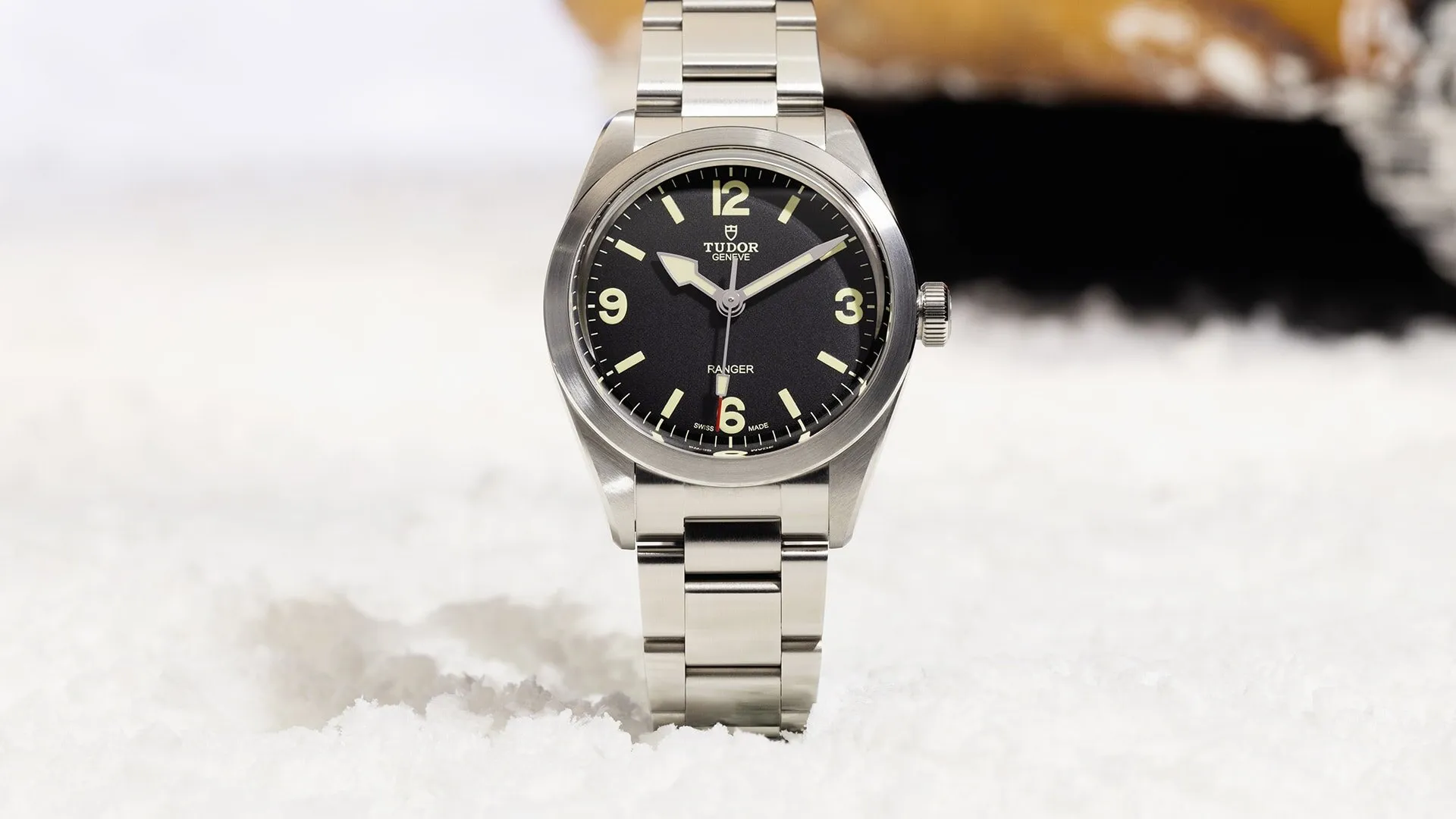
That’s why the Ranger looks the way it does. It has a plain steel case with a smooth bezel, big Arabic numerals at 3, 6, 9 and 12, an arrow-shaped hour hand you can’t mistake for the minute hand, and nothing else. Tudor settled on that face in the 1960s and has hardly touched it since. Today’s Ranger, a 39mm watch released in 2022 for the expedition’s 70th anniversary, puts Tudor’s own movement and about three days of power reserve inside a design that was already right. For where it sits in the range, see our guide to the best Tudor watches.
A name waiting for a watch
Tudor started as a way to sell Rolex’s reliability for less. Hans Wilsdorf, the founder of Rolex, had the Tudor name registered in 1926, wanting a watch his agents could offer at a more modest price without giving up the dependability Rolex was known for.
He registered the Ranger name three years later, in 1929, but it didn’t belong to any one watch. For decades it was an adventurous touch added to certain Tudors, such as a 1943 reference made for the Indian market. The name needed a story before it could become a model.
Greenland and the Oyster Prince
That story starts with the Oyster Prince, launched in 1952. Wilsdorf promised that every one would get two things that had until then been Rolex’s alone: the waterproof Oyster case, and the Perpetual rotor that winds the watch as the wrist moves. Tudor didn’t sell it with sport or glamour. Its first advertising showed men at work in hard conditions wearing a Tudor, with long text on strength and precision, and in 1953 it followed with stories of watches worn by a coal miner, a stonecutter, a pneumatic-drill operator and a motorbike racer.
The British North Greenland Expedition put the same watch somewhere harder. Twenty-six Oyster Princes went north in 1952 with a scientific party organised by the Royal Navy, and stayed until 1954. For Tudor it was proof that the Oyster Prince could take extreme conditions and keep time. The watches carried no Ranger name, but they set the brief that every Ranger since has followed: robust, practical and affordable.
The 1960s: the Ranger gets its face
The Ranger became a model of its own in the 1960s. Tudor’s timeline dates the Oyster Prince Ranger to 1965, and the look it settled on then is the one you can still buy: a black dial with luminous Arabic numerals at 3, 6, 9 and 12, and an arrow-shaped hour hand.
Both features come from the same need, which is reading the time at a glance in bad light. Big numerals at the quarters let you place the hands without counting markers, the same thinking behind the black dials and white Arabic numerals of the military watches of the Second World War. The arrow makes the short hand unmistakable, so you never read the minutes as the hour. Rolex reached a similar answer with the Explorer, unveiled after the 1953 Everest ascent with numerals at 3, 6 and 9 for legibility. Field watches from different makers end up looking alike because they’re solving the same problem.
The Ranger changed in small ways over the next decade. A 1969 version, the Prince Oysterdate Ranger, added a date and the shield logo that replaced Tudor’s rose, and a Ranger II followed in 1973. Tudor made Rangers with and without a date over the years.
Back in 2014, and again in 2022
The name came back with the Heritage Ranger in 2014: a 41mm watch with all the classic Ranger design elements except the word Ranger at 6 o’clock.
The current Ranger arrived in 2022, for the 70th anniversary of the Greenland expedition, and it’s the more faithful revival. It’s smaller at 39mm, the Ranger name is back on the dial, and the numerals and arrow hand are kept as they were. The big change is inside: the new watch runs Tudor’s own MT5402, certified as a chronometer by COSC (the Swiss testing body). Its balance is held by a bridge fixed at both ends rather than one, which steadies it against knocks, and it runs for about 70 hours off the wrist: take it off on Friday night and it’s still going on Monday morning. The bracelet gained Tudor’s T-fit clasp, which adjusts in five steps without tools.
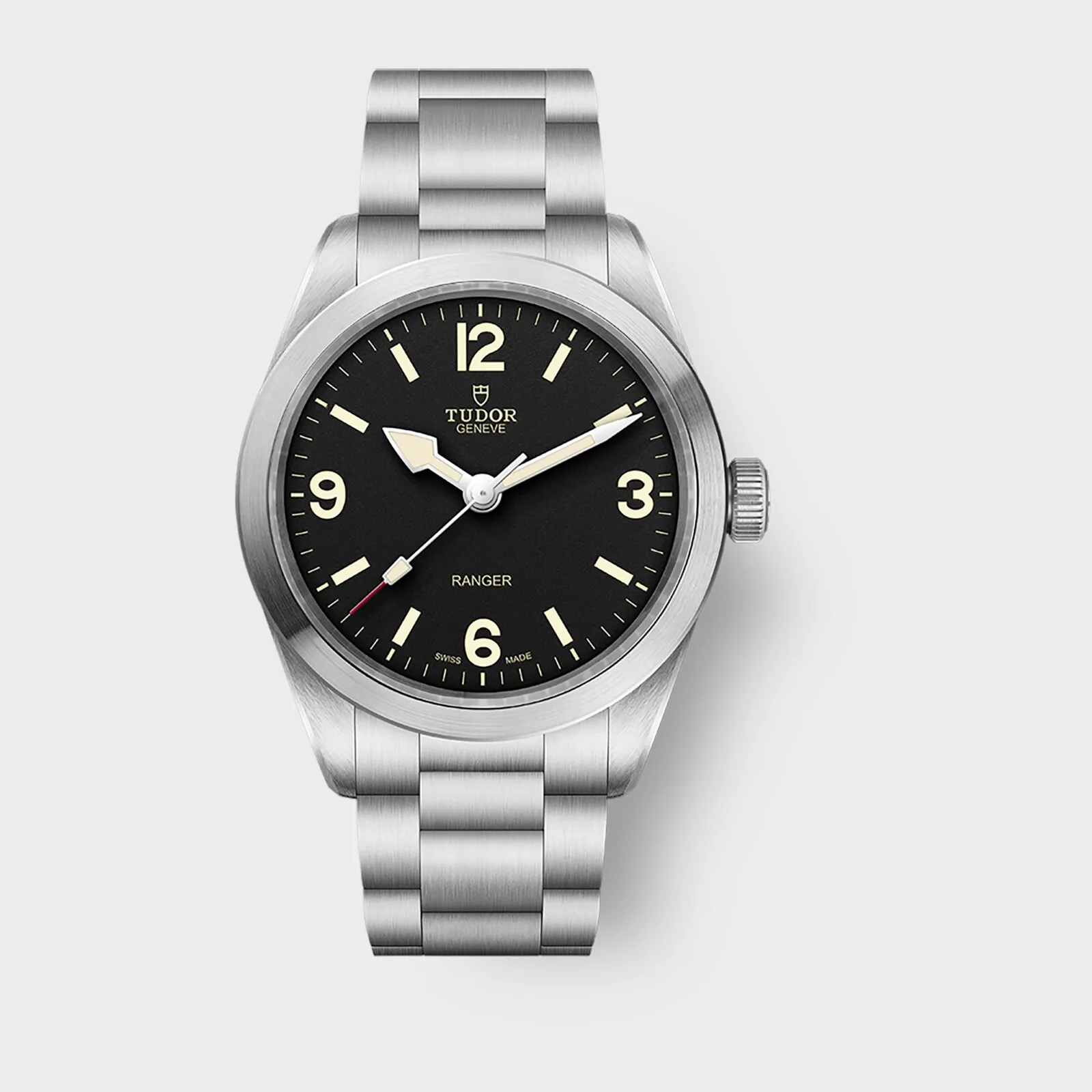
Ranger 39 on the steel bracelet. Image: Tudor
Why it has so little on the dial
What the Ranger leaves out is as much a part of its character as what it keeps. There’s no date: Tudor has made Rangers both ways, and the current one goes without, which keeps the dial as clean as the 1960s originals. The bezel is smooth steel rather than a rotating timer, because a field watch has no dive to time. The dial is matt and grained rather than glossy, which keeps reflections down, and the crystal is domed sapphire.
The case is satin-brushed steel with a screw-down crown, water resistant to 100m. That’s the Oyster idea carried on: enough for rain, swimming and the odd knock, without the bulk of a dive watch.
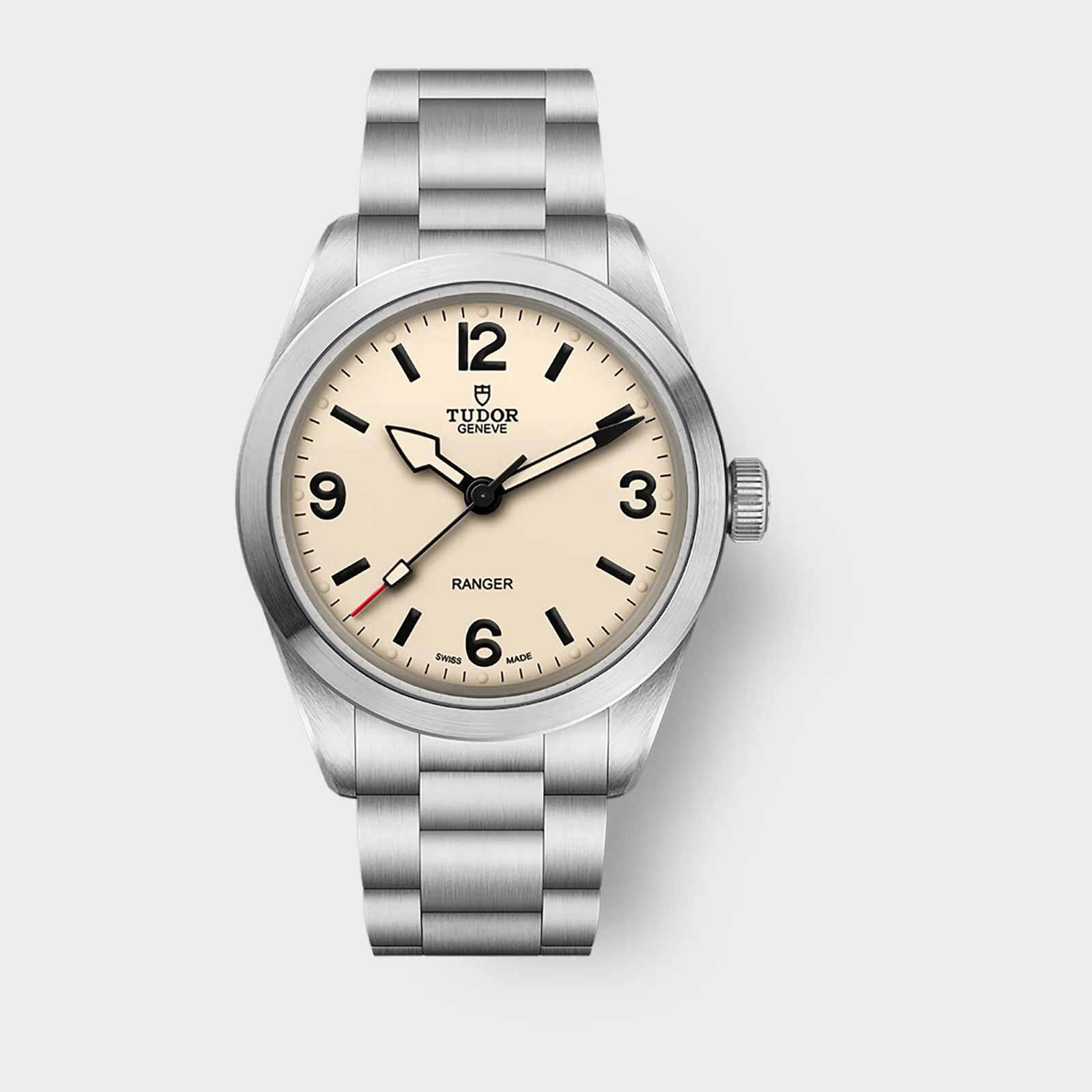
Ranger 39 with the beige dial. Image: Tudor
The Ranger today: sizes and prices
Tudor makes the Ranger in two sizes, each with a black or beige dial and a choice of steel bracelet or fabric strap. A 36mm version joined the 39 later, for slimmer wrists, with Tudor’s MT5400 movement and the same 70 hours and 100m.
| Ranger 39 | Ranger 36 | |
|---|---|---|
| Reference | M79950 | M79930 |
| Movement | MT5402, COSC, about 70 hours | MT5400, COSC, about 70 hours |
| Case | 39mm steel, about 12mm thick, 47mm lug to lug | 36mm steel, about 11mm thick, 44mm lug to lug |
| Water resistance | 100m | 100m |
| Price on fabric strap | $5,110 | $4,960 |
| Price on steel bracelet | $5,630 | $5,480 |
Prices are Tudor’s at the time of writing. Thickness and lug-to-lug figures are Fratello’s measurements; Tudor doesn’t publish them.
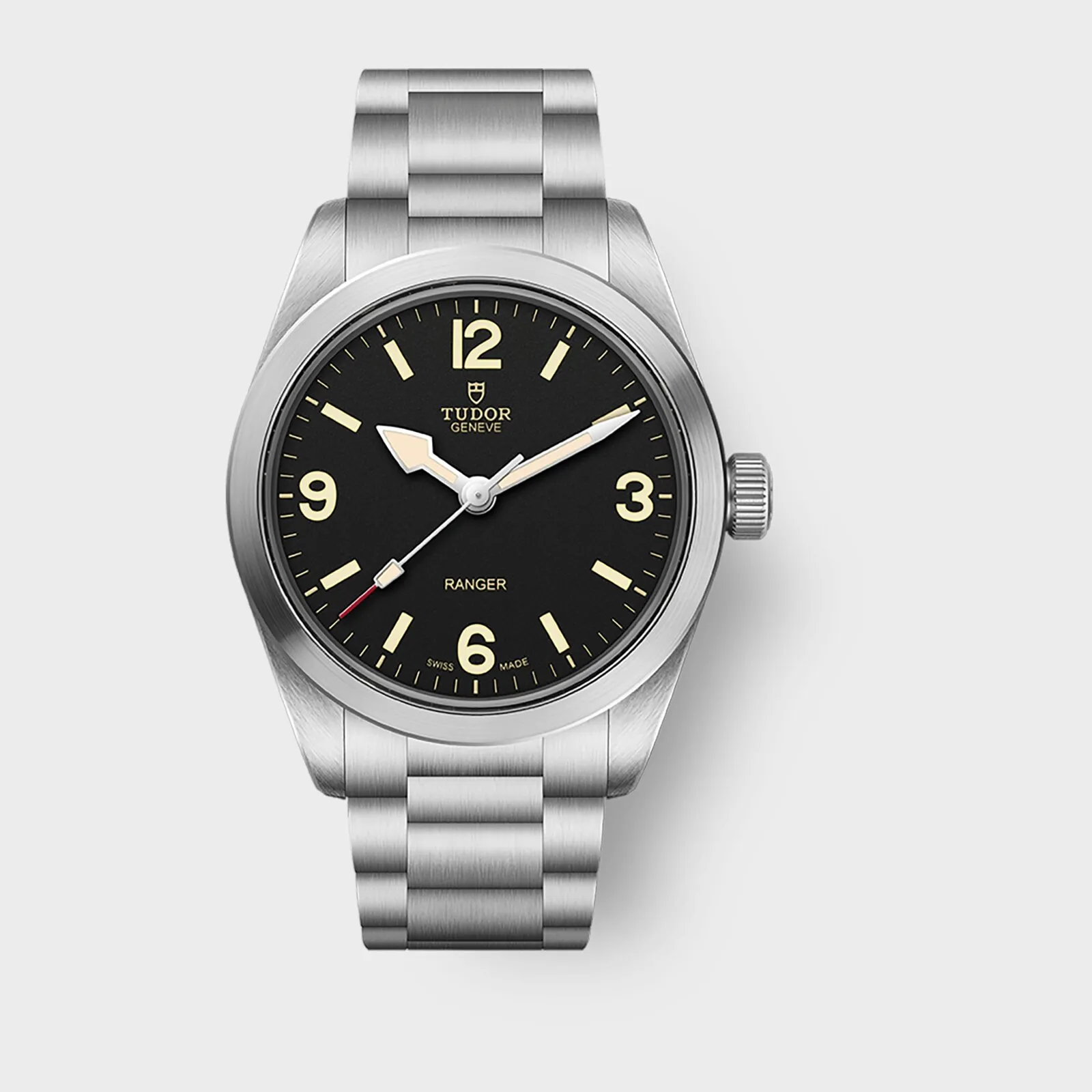
Ranger 36. Image: Tudor
The Ranger is the most affordable of Tudor’s sports watches. The Black Bay 58, the same size in steel, costs about $1,700 to $1,900 more and adds a dive bezel, 200m and METAS certification. The Rolex Explorer, the closest rival in spirit, lists at $13,250 for the 36mm and $14,050 for the 40mm, about two and a half times the Ranger.
You can buy a Ranger at Tudor’s boutiques in Sydney, Melbourne and Brisbane, or through authorised dealers including Watches of Switzerland in Sydney, Melbourne and Perth.
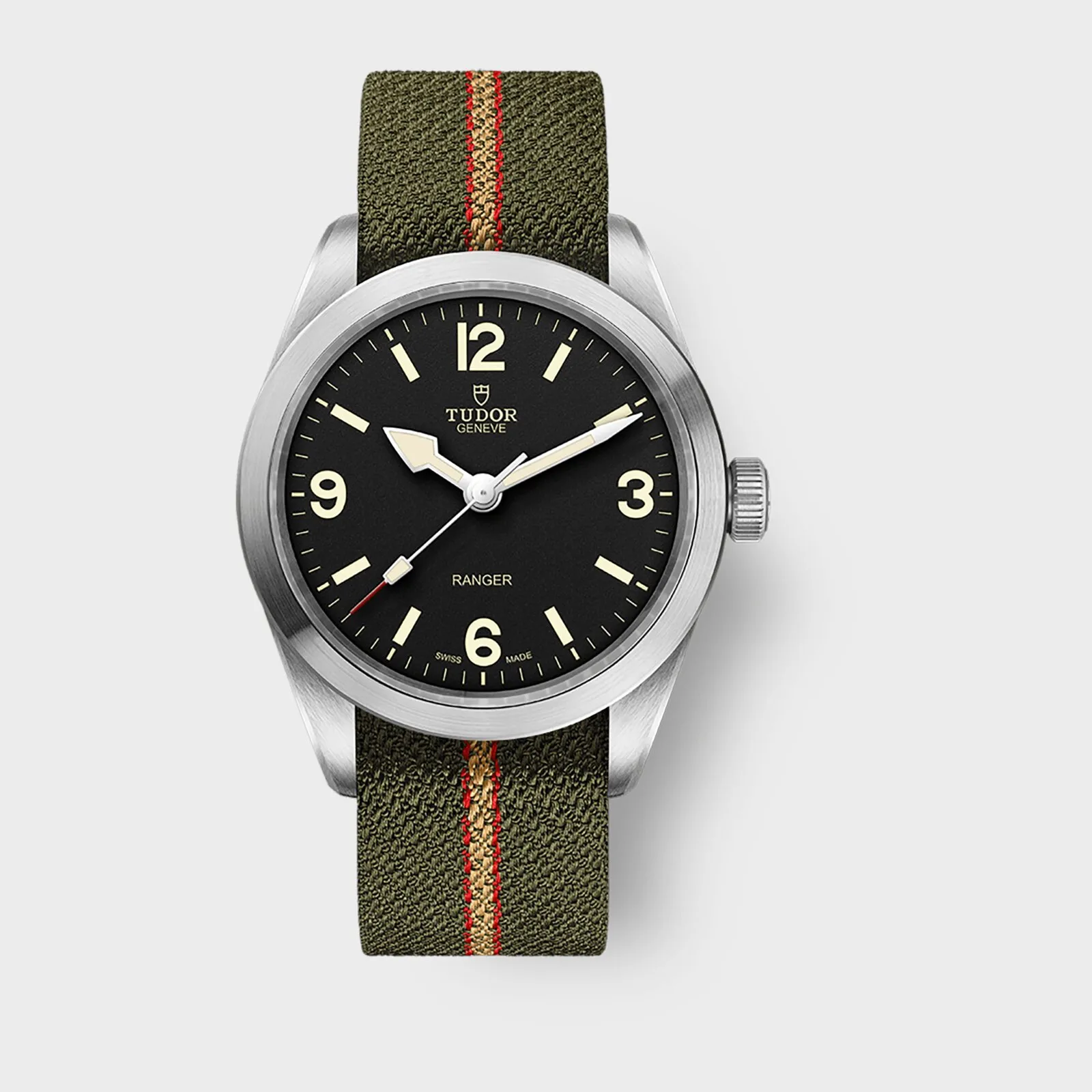
Ranger 39 on a fabric strap. Image: Tudor