Tudor Pelagos: The Lightweight Titanium Tool Watch
From the French Navy's Tudor Submariners to the titanium Pelagos 42, 39 and FXD: how the watch came to be, why it has a helium valve and a self-adjusting clasp, and what each version costs in Australia.
In 1956, the French Navy’s diving research group in Toulon took delivery of Tudor Submariners to put through their paces. The watches passed, and the Navy kept ordering Tudors for decades. They were engraved “M.N.” with the year of issue, worn on straps cut from parachute elastic, and still on divers’ wrists into the 2000s.
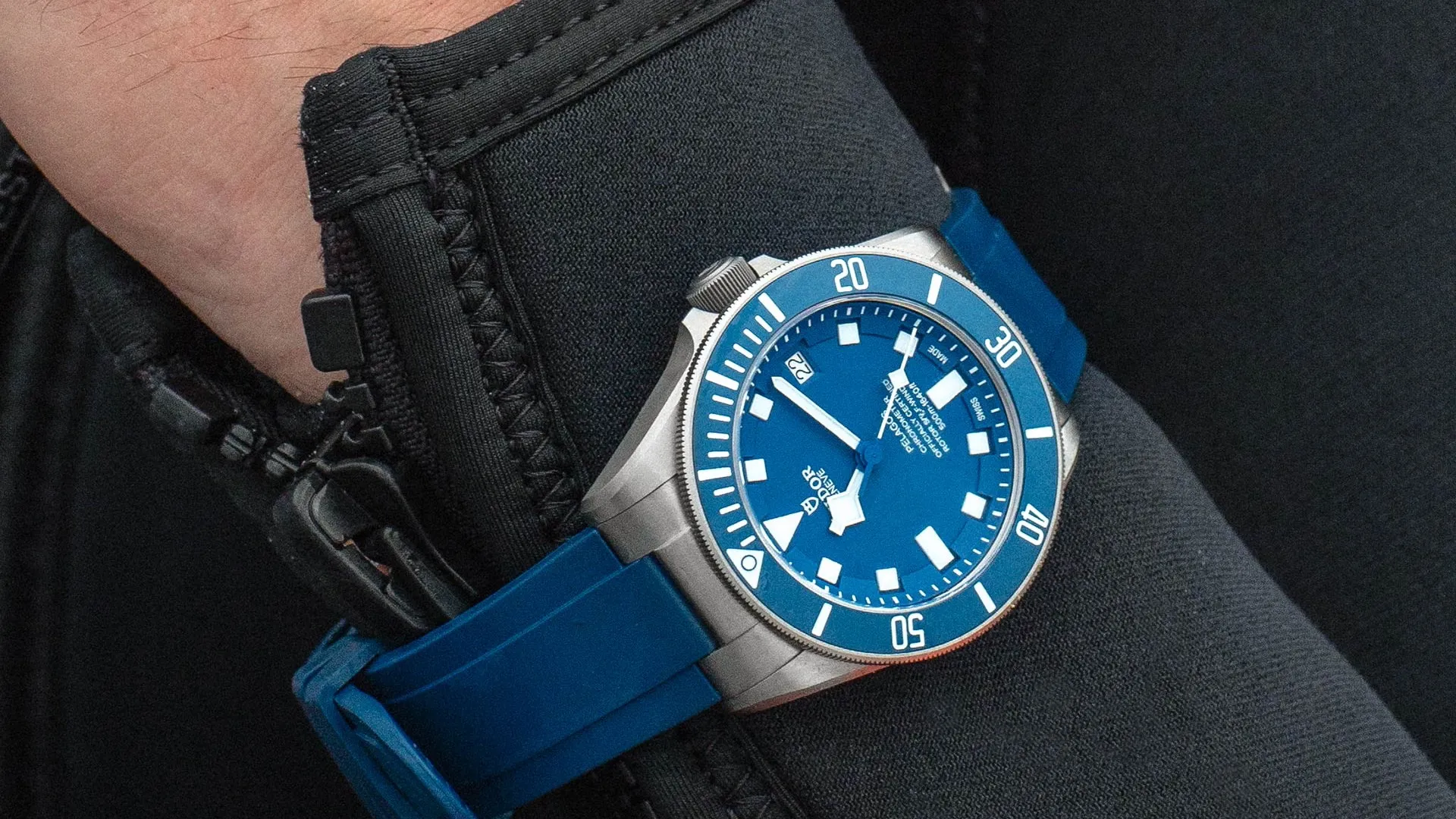
The Pelagos is where that history leads. Most dive watches never go deeper than a hotel pool, and their bezels and depth ratings are mostly there for the look. Nearly everything on the Pelagos exists because a professional diver needed it: a titanium case that salt water can’t touch, a valve that lets out helium after weeks in a pressurised chamber, and a clasp that tightens itself as a wetsuit compresses at depth. Even the name is the Greek word for the open sea. It sits at the tool end of Tudor’s range, next to the dressier, steel Black Bay.
How the French Navy shaped Tudor’s dive watches
Tudor’s first dive watch, the Oyster Prince Submariner of 1954, was water resistant to 100m. When the Navy’s research group (the Groupement d’Etude et de Recherches Sous-Marines) tested two versions in 1956, its commander reported back that they were completely watertight and kept good time. In 1958 the Navy asked for 200m, and Tudor’s answer was the reference 7924. A year later the 7928 added guards either side of the crown to protect it from knocks, and the Navy took it as soon as the first examples were ready.
Most of what makes a Tudor diver recognisable came out of this relationship. The square-tipped “Snowflake” hour hand arrived on the 1969 reference 7016, giving a bigger area of luminous paint, which made the time easier for Navy divers to read underwater. From 1974 the Navy’s watches were engraved with its initials and the year they were issued. The best known of them, the blue-dialled reference 9401 of 1975, was delivered into the 1980s and worn at the Navy’s diving school and by its combat swimmers into the 2000s. The Navy usually ordered them without a bracelet, and divers wore them on black braided nylon or on bands sewn from green parachute elastic with a red or yellow thread down the middle. Tudor’s own history tells the story in more detail.
The modern Pelagos arrived in 2012, launched at Baselworld alongside the first Black Bay. The two split Tudor’s diving history between them: the Black Bay took the look of the 1950s Submariners, and the Pelagos took what the divers had actually needed from them and rebuilt it with modern materials. The first one used a bought-in movement; today’s runs on Tudor’s own.
Why it’s made of titanium
Titanium doesn’t rust or pit in salt water, and it weighs a little over half as much as steel for the same volume. Both matter more on a dive watch than anywhere else. A watch that spends its life in the sea needs a metal the sea can’t eat, and a heavy watch on a loose wetsuit sleeve slides around the wrist.
It also gives the Pelagos its look: a flat, dark grey with no polish to catch the light. Hodinkee weighed the smaller Pelagos 39 at about 107g on an unsized bracelet, which is light for a 39mm diver on a metal bracelet. The bezel inserts are ceramic, which shrugs off the scratches an aluminium insert picks up against rocks and boat ladders, and the graduations are filled with luminous material so the elapsed time stays readable at depth.
Why there’s a valve on the side
The Pelagos 42 has a small valve at 9 o’clock that most owners will never use. It’s there for saturation divers, who work at depth for days or weeks and live between shifts in a pressurised chamber breathing a mix of helium and oxygen. Helium atoms are small enough to work their way past a watch’s seals over that time. When the diver decompresses on the way out, the gas trapped inside the watch can’t escape as fast as the pressure outside drops, and it can push the crystal out. The valve lets it out first.
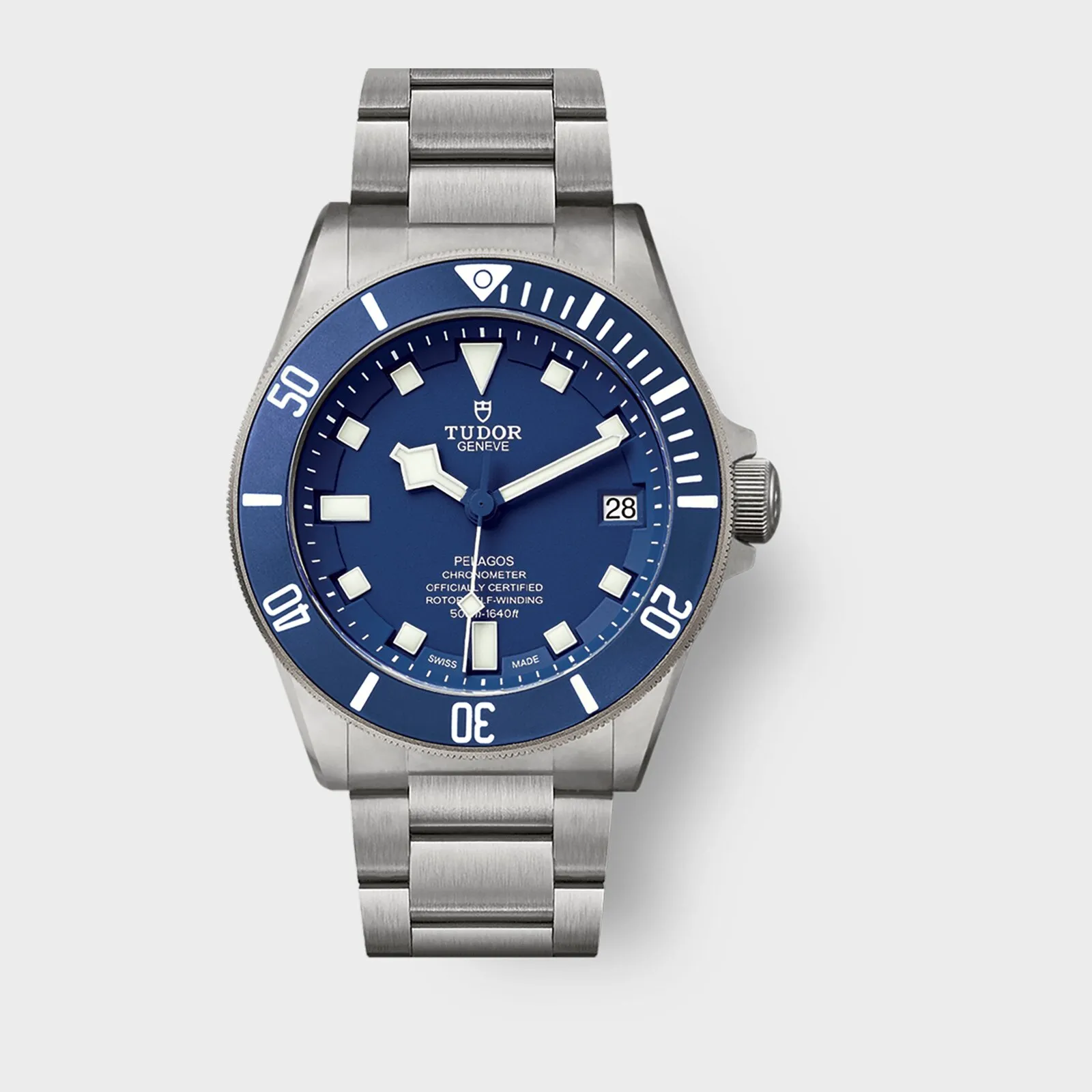
Pelagos 42 in blue. Image: Tudor
The 42 is built for that world, and it’s rated to 500m, more than twice the depth of the Pelagos 39. Its 42mm case, 14.3mm thick, is titanium and steel, and it runs Tudor’s COSC-certified MT5612 with about 70 hours of power reserve.
Why the clasp adjusts itself
A wetsuit compresses as a diver goes down, because the gas bubbles in the neoprene shrink under pressure, and expands again on the way up. A bracelet sized at the surface goes loose at depth. The 42’s clasp has a spring-loaded extension that Tudor developed and patented, which takes up the slack as the suit compresses and lets it out again on the ascent, so the watch stays put without the diver touching it. Tudor puts a black rubber strap in the box as well.
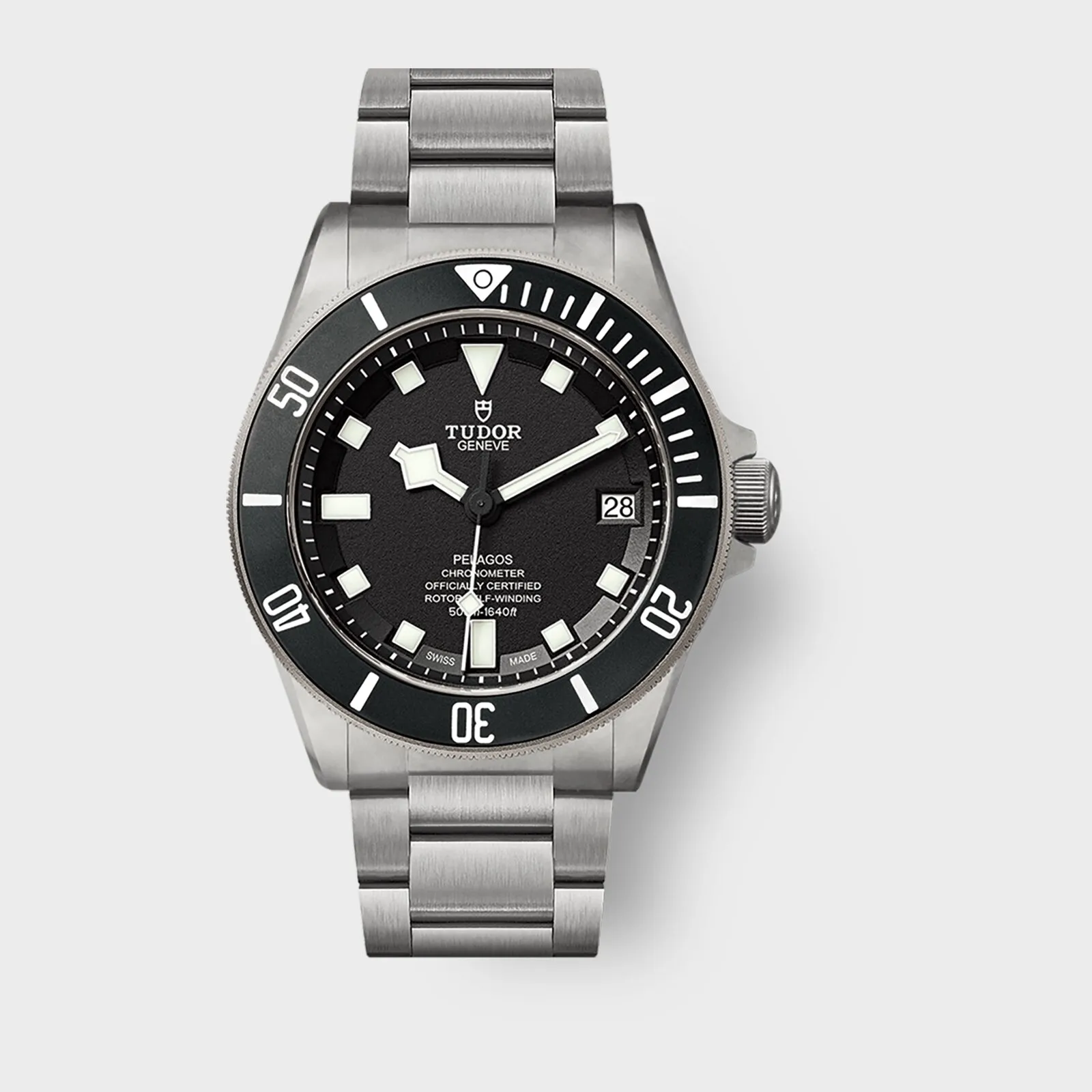
Pelagos 42 in black, with the Snowflake hour hand. Image: Tudor
Why there’s a left-handed version
In the 1970s the French Navy commissioned Tudors for its left-handed divers, with the crown moved to the other side so it wouldn’t dig into the back of the hand when the watch was worn on the right wrist. The Pelagos LHD brings that back: the crown sits at 9 o’clock and the helium valve moves to 3. It comes in black only, with beige lume on the bezel and even dates printed in red, at the same $8,470 as the standard 42.
The FXD: built with the Navy again
The Pelagos FXD is the most direct link to that history. Tudor developed it with a specialist unit of the French Navy for underwater navigation, where divers swim a compass course in legs without surfacing.
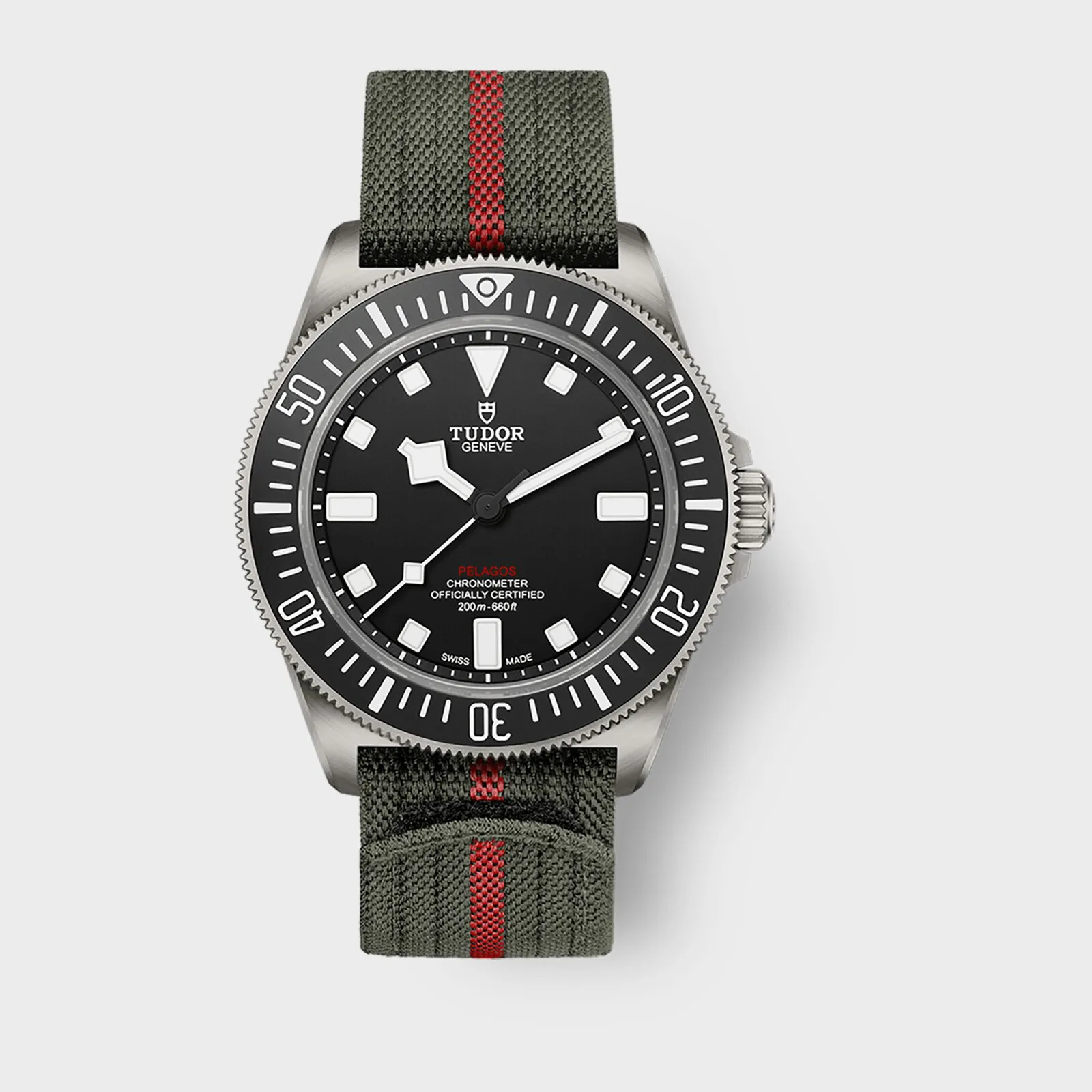
Pelagos FXD, the fixed-lug version. Image: Tudor
Each feature follows from that job. The bezel turns both ways and counts down a 60-minute scale, so a diver can time each leg of the course rather than only the dive. FXD stands for the fixed bars: the strap threads through bars fixed into the case, so there are no spring bars to fail. And the strap is fabric, as the Navy’s watches always were; the green version with a red band echoes the old parachute-elastic straps. The 42mm titanium case is 12.75mm thick and 52mm lug to lug, it’s water resistant to 200m, and it runs the COSC-certified MT5602. Hodinkee took one diving and found it comfortable underwater despite its size.
Tudor has since stretched the FXD beyond diving. The FXD GMT ($7,660) was developed for French naval aviation, with a 24-hour bezel and a second time zone. The FXD Chrono Cycling Edition ($8,960) is a 43mm carbon-composite chronograph made for Tudor’s professional cycling team.
The Pelagos 39: the same idea for everyday wear
The Pelagos 39 keeps the titanium and the look, and drops the specification that matters only at depth. Its 39mm grade 2 titanium case is 11.8mm thick and, by Hodinkee’s measure, 47mm from lug to lug, so it sits inside the edges of most wrists. It’s water resistant to 200m, has no helium valve, and swaps the self-adjusting clasp for Tudor’s T-fit, which has a 25mm diver’s extension for a wetsuit and five positions of fine adjustment without tools. It runs the COSC-certified MT5400, with about 70 hours of reserve.
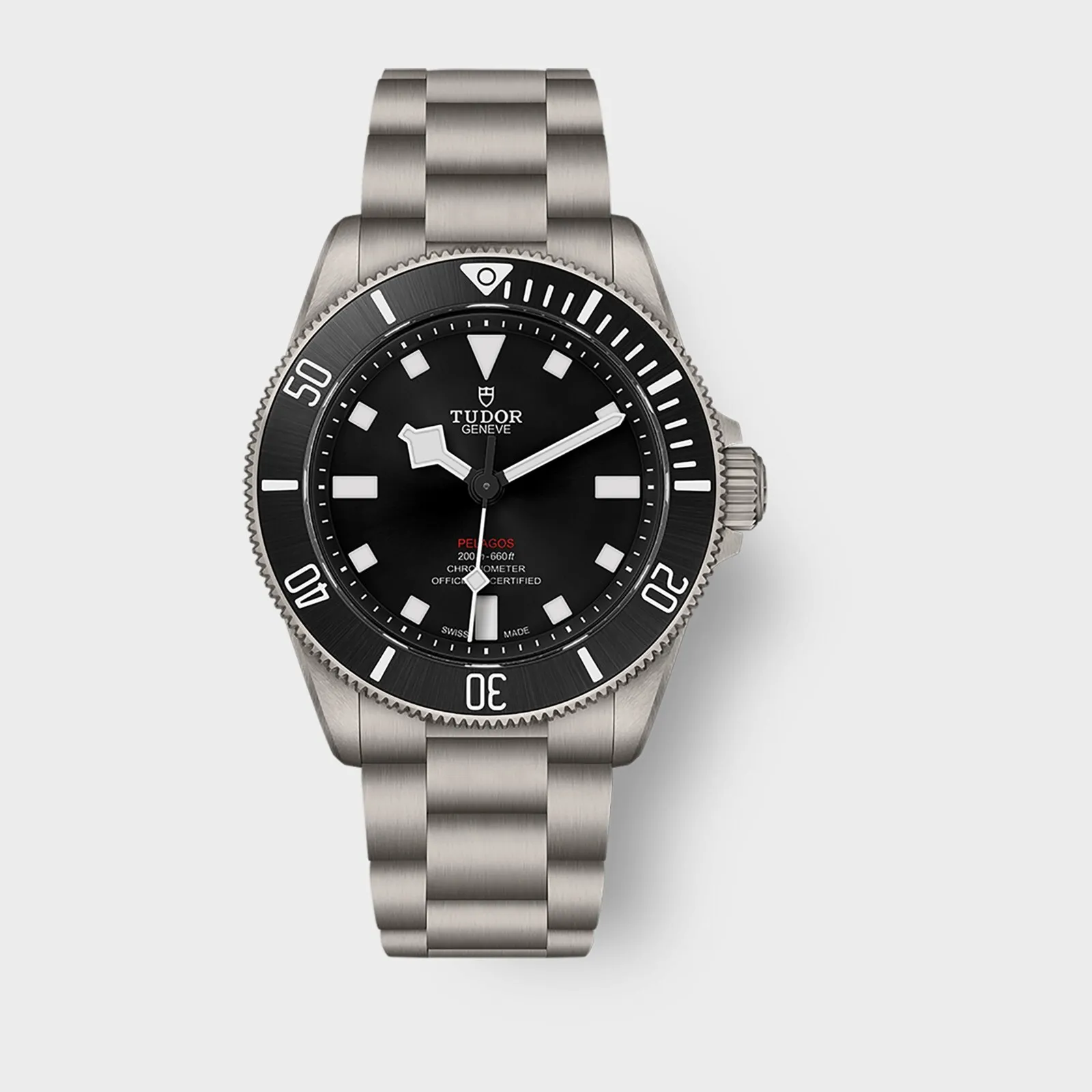
Pelagos 39. Image: Tudor
Hodinkee named it its tool watch of the year for 2022, and suggests it for anyone who dives occasionally or not at all, leaving the 42 for those who dive a lot. For most people, the 39 is the Pelagos to buy.
At the other extreme, the Pelagos Ultra ($9,640) takes the saturation-diving idea as far as it goes: a 43mm titanium case rated to 1,000m, with a METAS-certified movement and lume in two colours.
Where the Pelagos sits against its rivals
Tudor’s other 39mm diver, the Black Bay 58, costs $7,330 on a steel bracelet. It’s the better choice with a suit, the Pelagos 39 the better one in the water. Omega’s Seamaster Diver 300M starts at $9,925 on rubber, and its titanium version is the 007 Edition from James Bond’s watches, at $15,800 on a strap. Rolex’s Submariner starts at $16,850.
Tudor and Rolex were both founded by Hans Wilsdorf, but the Pelagos’s movements are Tudor’s own. For about half the price of a Submariner, it gets you an in-house, chronometer-certified diver in titanium, with a better claim than most to having been shaped by people who dived for a living.
Prices and where to buy in Australia
Tudor’s Australian prices, at the time of writing:
| Model | Case | Water resistance | Price |
|---|---|---|---|
| Pelagos 39 | 39mm titanium | 200m | $7,920 |
| Pelagos 42 (black or blue) | 42mm titanium and steel | 500m | $8,470 |
| Pelagos LHD | 42mm titanium and steel | 500m | $8,470 |
| Pelagos Ultra | 43mm titanium | 1,000m | $9,640 |
| Pelagos FXD | 42mm titanium | 200m | $7,060 |
| Pelagos FXD GMT | 42mm titanium | 200m | $7,660 |
| Pelagos FXD Chrono | 43mm carbon composite | 100m | $8,960 |
Tudor has boutiques in Sydney (King Street), Melbourne (Collins Street and Chadstone) and Brisbane (Edward Street), and authorised dealers including Watches of Switzerland in Sydney, Melbourne and Perth. Every Tudor comes with a five-year guarantee that transfers to a new owner and needs no registration.