Tudor Black Bay Chrono: The Racing Chronograph, Tudor's Way
From the 1970 "Home Plate" and the roulette-wheel "Montecarlo" to the Breitling-based movement and the new 39mm model: where each detail comes from, and how it compares with a Daytona and a Speedmaster.
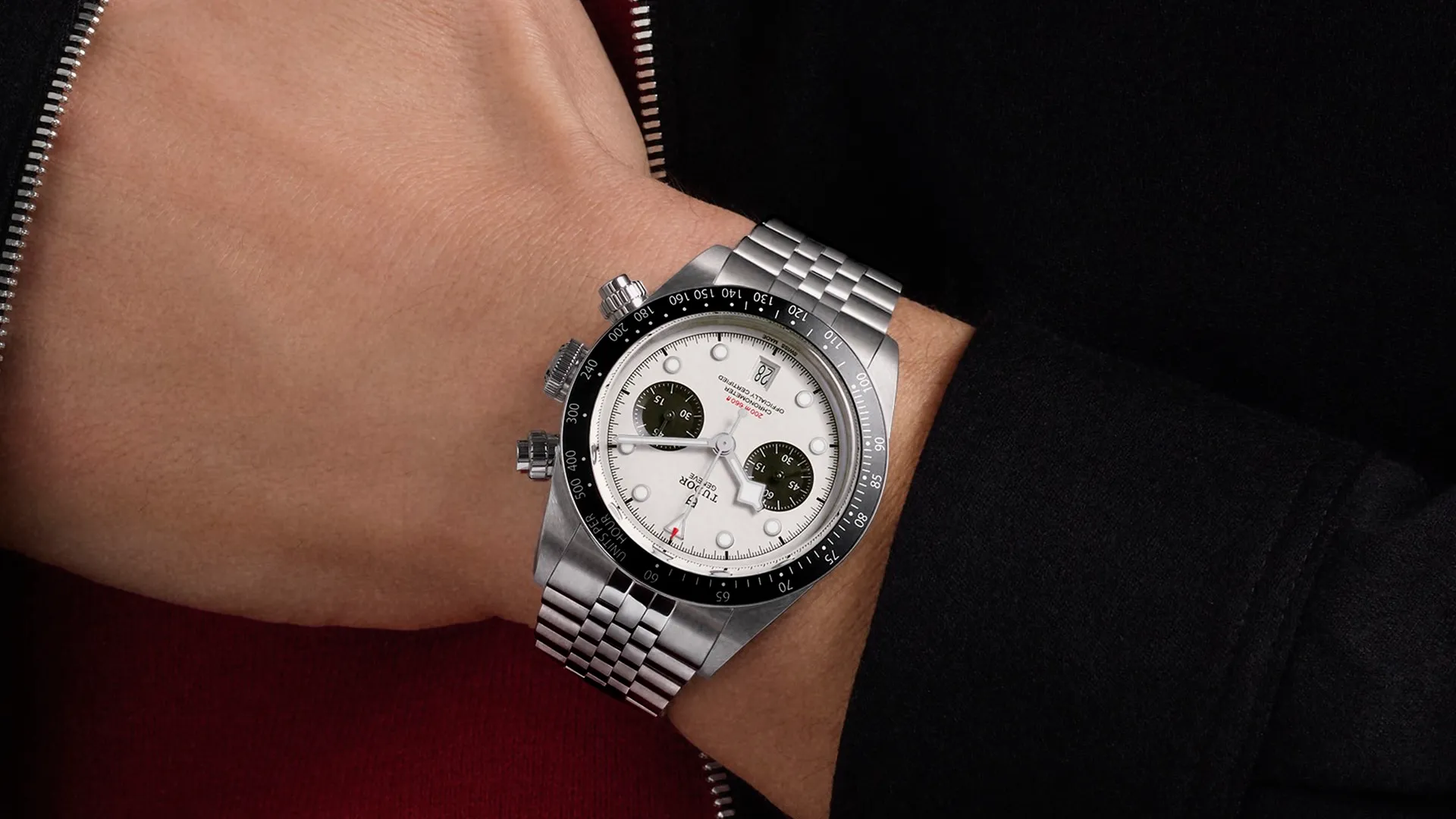
The Black Bay Chrono is Tudor’s racing chronograph: a 41mm steel watch with a tachymeter bezel and a two-tone dial, either white with black counters (the “panda”) or black with white ones (the “reverse panda”). It looks as if it belongs in a 1970s pit lane, and that’s deliberate. Tudor’s first chronographs arrived in 1970 with motor sport in mind, and the Black Bay Chrono puts their look on Tudor’s dive-watch case.
It’s the racing chronograph from Rolex’s sister brand at about a third of the price of a steel Daytona. It’s water resistant to 200 metres, its pushers screw down, and its COSC-certified movement runs for about 70 hours, from $9,680. A 39mm version joined it in 2026. It sits in our guide to the best Tudor watches.
Tudor’s first chronographs: Home Plate and Montecarlo
Tudor’s first chronograph, the Oysterdate, came out in 1970. It had a hand-wound Valjoux 7734 movement in a 39mm case, with a grey dial, black counters and bold graphics. There were two versions: the 7031 with a Plexiglas bezel insert, and the 7032 with a steel bezel engraved with the same tachymeter scale. A third, the 7033 with a rotating bezel, never got past the prototype stage. Collectors call this first series the “Home Plate”, after its five-sided luminous hour markers, which look like the plate in baseball.
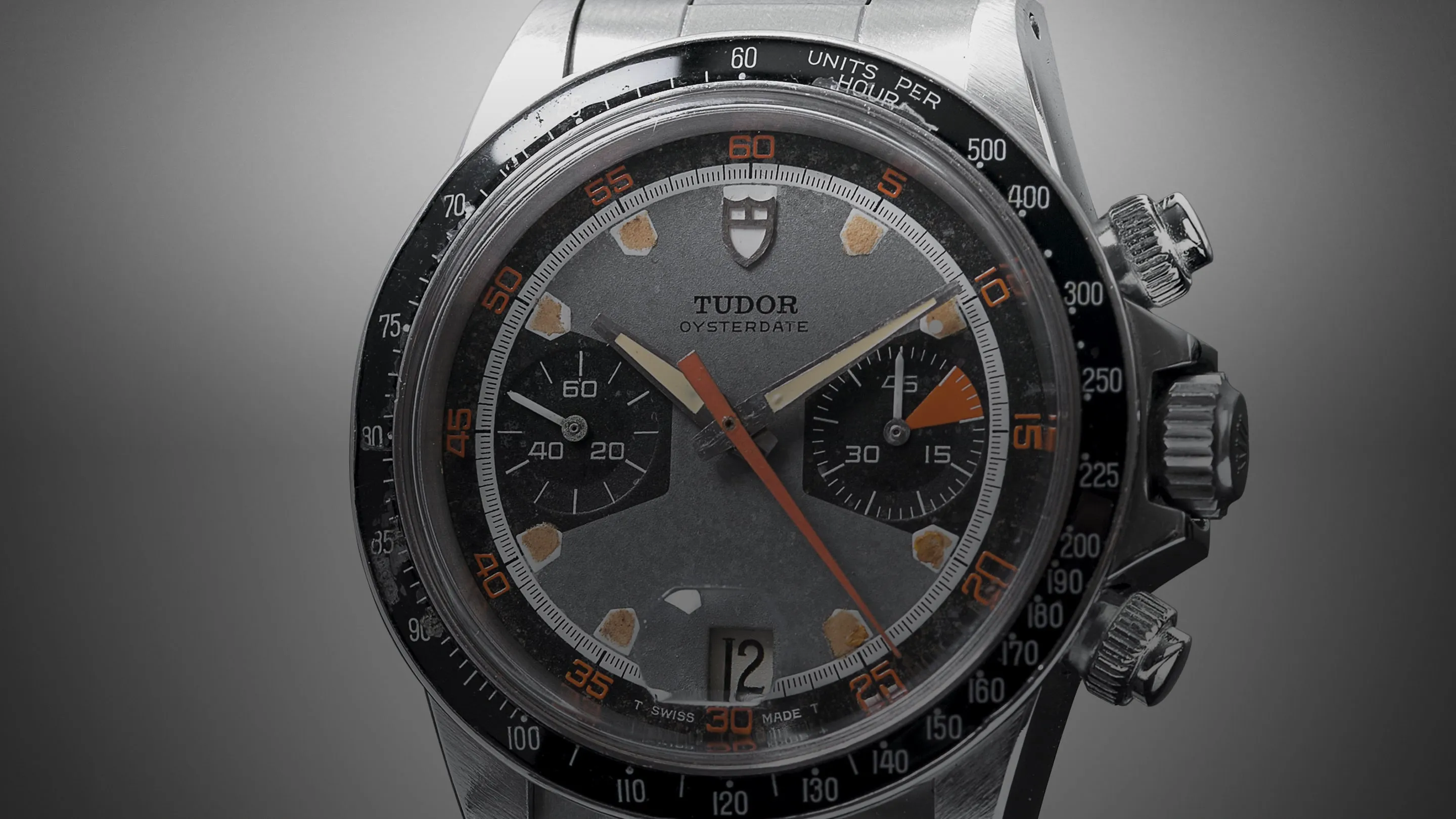
An early Tudor Oysterdate chronograph from 1970. Image: Tudor
A year later Tudor replaced it. The second series of 1971, the 7149, 7159 and 7169, had a blue and grey dial that recalls a casino roulette wheel, which is why collectors call it the “Montecarlo”. The bigger change was inside. The new Valjoux 234 beat faster, at 21,600 vibrations an hour rather than 18,000, and it ran the chronograph through a column wheel and clutch, the layout the Black Bay Chrono still uses. The 7169 put the rotating bezel into production, and the Montecarlo stayed in the catalogue until 1977.
In 1976 came the third family, Tudor’s first self-winding chronographs. The cases grew thicker to make room for the winding rotor, and collectors named them “Big Block”. The line carried on into the 79100 series of 1989.
Why the Black Bay Chrono looks the way it does
The Black Bay Chrono arrived at Baselworld in 2017 as the first chronograph in the Black Bay line. Tudor describes it as joining its two traditions, the dive watches it has made since 1954 and the motor-sport chronographs it has made since 1970, and nearly every detail comes from one or the other.
The bezel carries a tachymeter, the scale the 1970 Oysterdate used to work out average speed between two points. Start the chronograph at one kilometre marker and stop it at the next, and the seconds hand points to your speed on the bezel: 30 seconds reads 120km/h. The minute counter runs to 45 rather than the usual 30, and Tudor says both it and the date window at six were inspired by its first chronographs.
The hour hand is a snowflake, the shape Tudor has used on its dive watches since 1969, adapted here for a chronograph. The dive side also explains the case. Every pusher is another way in for water, so on the Black Bay Chrono both pushers screw down, like the crown, and the watch keeps the 200-metre rating of a Black Bay diver.
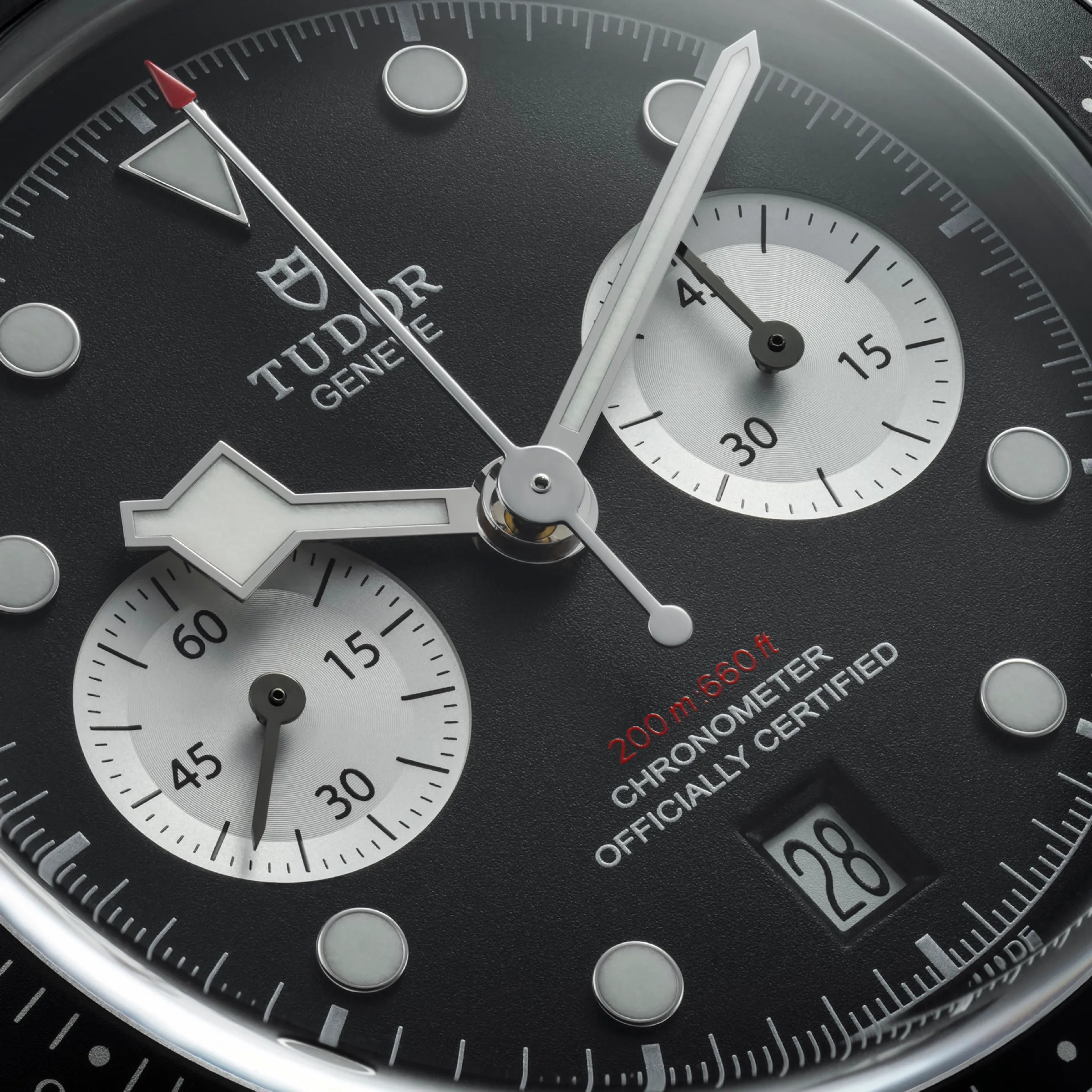
The black “reverse panda” dial, with pale counters and the date at six. Image: Tudor
The steel bracelet comes in two styles, a five-link and a three-link with rivet heads down the sides. The riveted look comes from the folding bracelets Tudor made in the 1950s and 1960s, as on the Black Bay GMT. Both close with Tudor’s T-fit clasp, which adjusts by 8mm in five steps without tools, handy when your wrist swells on a hot day.
A Breitling heart, and the swap behind it
Tudor calls the MT5813 a Manufacture calibre. It’s self-winding, COSC-certified, runs for about 70 hours and works its chronograph through a column wheel and a vertical clutch. The clutch engages the chronograph by friction rather than by meshing gears, so the seconds hand starts without a jump.
What Tudor’s own pages don’t mention is where the movement comes from. When the watch launched in 2017, SJX reported that Breitling makes it for Tudor as a version of its B01, the first movement Breitling built entirely in-house. Tudor fits its own balance with a silicon balance spring, its own rotor and finishing, and swaps the 30-minute counter for its 45.
It was a swap. In return, Revolution reported, Breitling took a version of Tudor’s MT5612 automatic, finished it with its own rotor and named it the B20 for the Superocean Heritage. Tudor got a column-wheel chronograph for the Black Bay without building one from scratch.
The range: panda, reverse panda, gold and the 39mm
The 41mm steel watch is the core of the range, in either dial. Everything else is a variation on it:
- Steel, black or white dial, on a bracelet: $9,680 or $9,850, depending on the bracelet.
- Steel with a blue dial (boutique edition), pink or turquoise dial: $9,850.
- Steel and gold, black or champagne dial: $11,960 on a strap, $15,200 on a bracelet.
- Black Bay Chrono 39, yellow dial: $9,480.
- Carbon 26, 42mm carbon composite case with a white dial: $12,140.
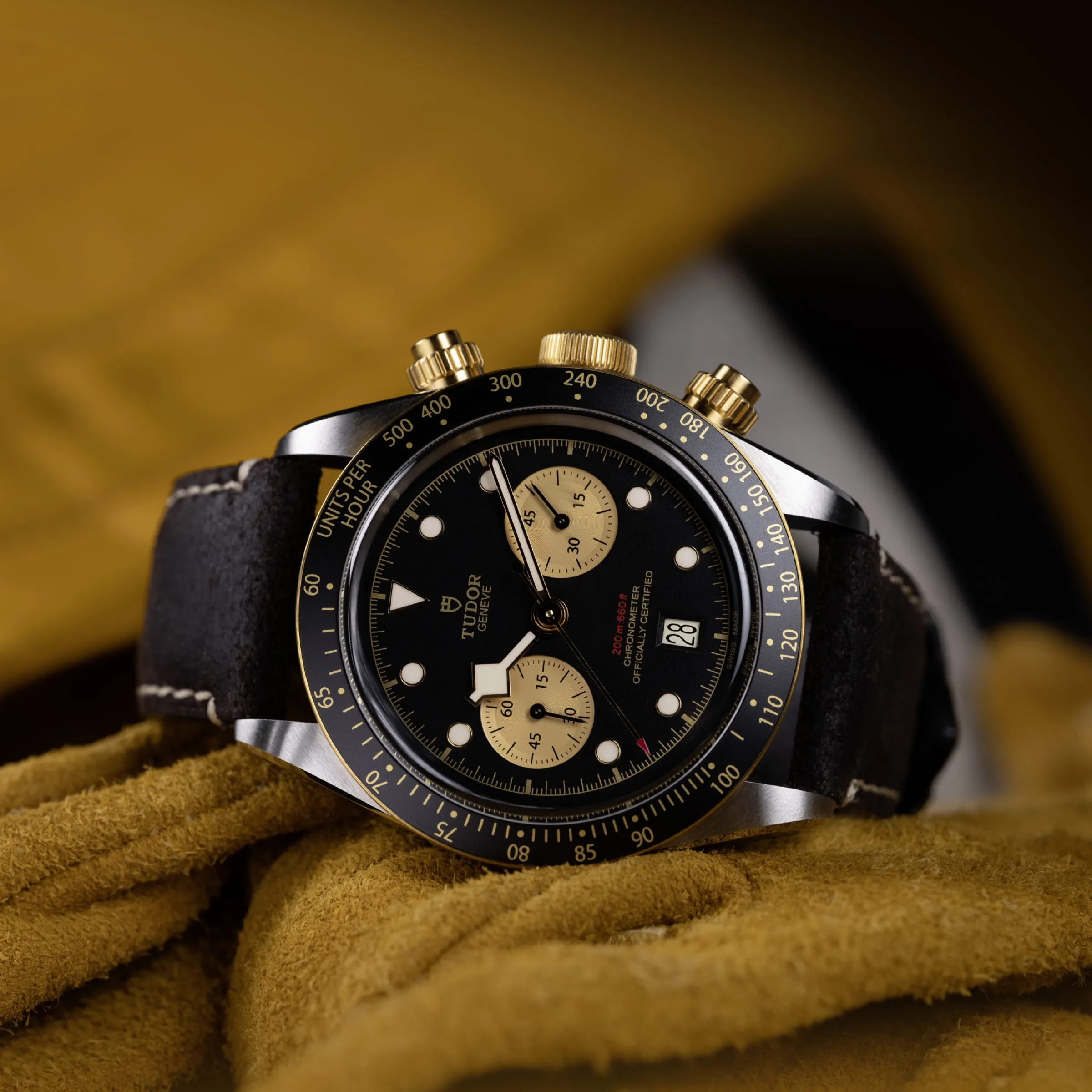
The steel-and-gold Black Bay Chrono, with gold pushers and a black dial. Image: Tudor
In June 2026 Tudor added the first smaller case, the Black Bay Chrono 39. It has a yellow dial with black counters, which SJX’s launch report calls the Bumblebee. It’s 13.1mm thick against the 41’s 14.4mm and has 20mm lugs rather than 22mm, so it suits smaller wrists. The movement, the 200-metre rating and the tachymeter are the same, and it comes on the three-link bracelet for $9,480, a little less than the 41.
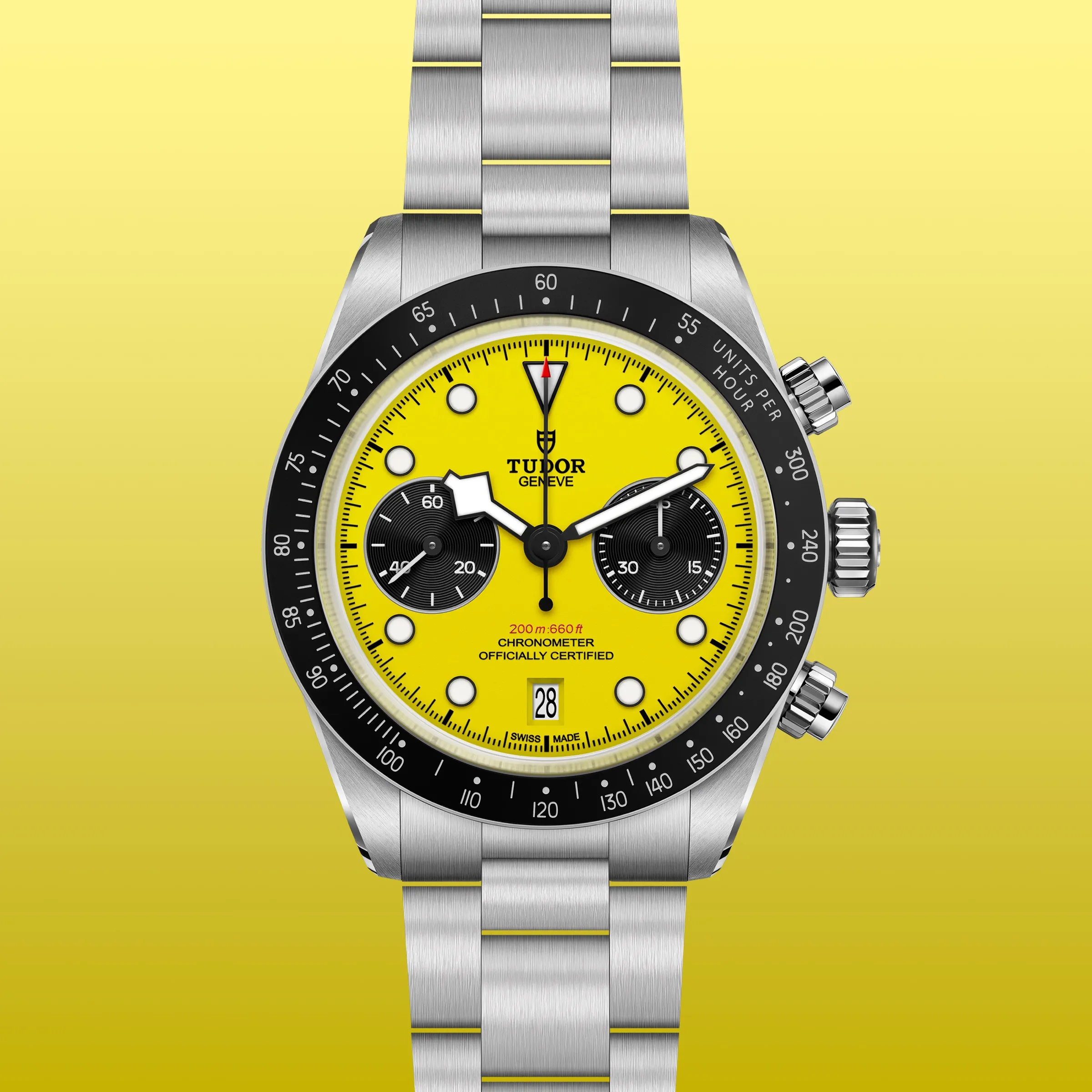
The Black Bay Chrono 39 with its yellow dial. Image: Tudor
Price and how it compares
The steel Black Bay Chrono costs $9,680 or $9,850 on a bracelet, with Tudor’s five-year transferable guarantee. The panda and reverse panda are the classic choice. The 39 is the one to try first if a 41mm chronograph sits too tall on your wrist.
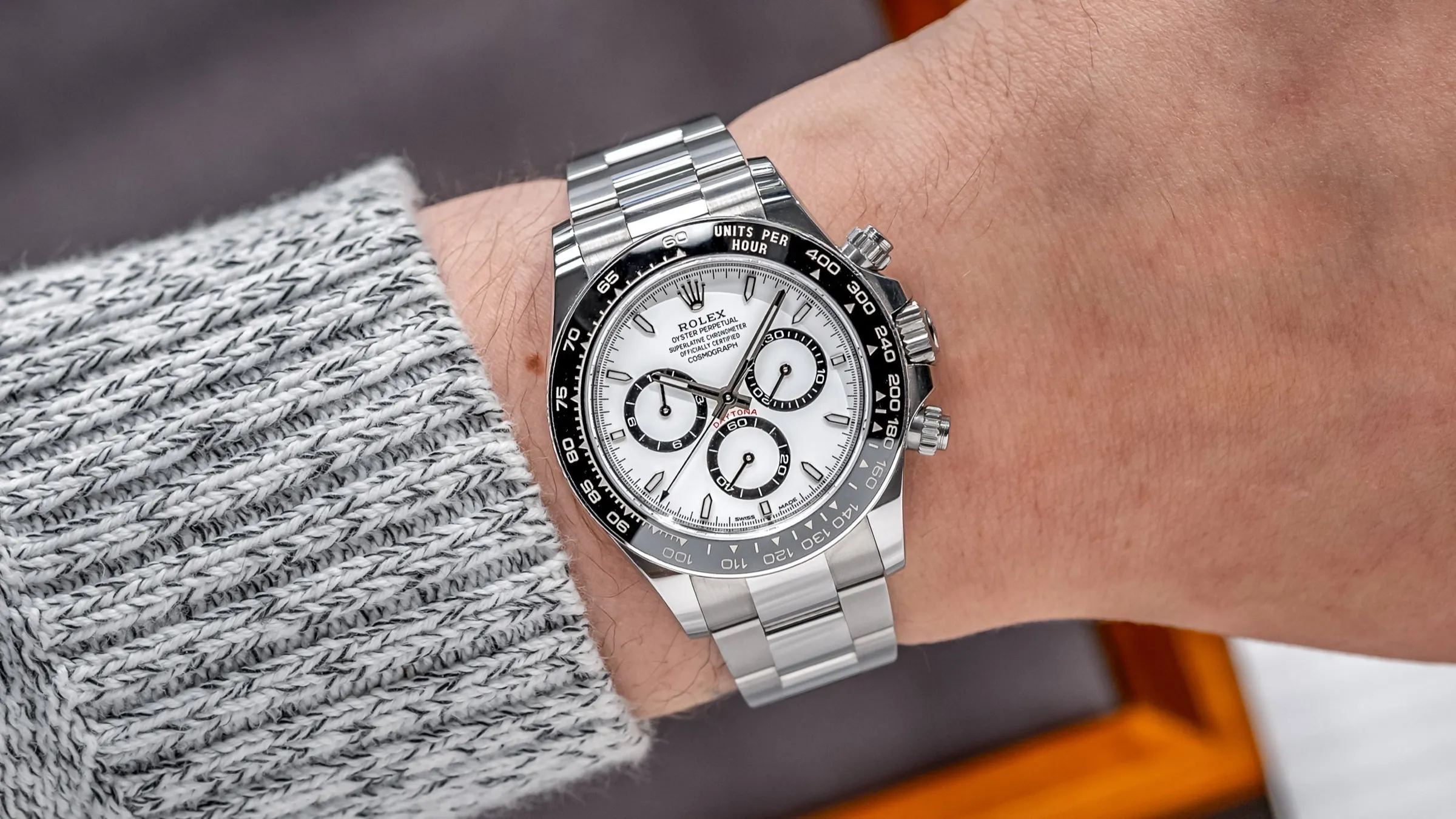
The obvious comparison is the Rolex Cosmograph Daytona, Rolex’s own racing chronograph. A steel one on an Oyster bracelet costs $28,200, nearly three times as much. For that you get Rolex’s Calibre 4131 with about 72 hours of reserve, a ceramic tachymeter bezel, a 40mm case and a 30-minute counter.
The Omega Speedmaster Moonwatch is the other classic chronograph, with a story about space rather than the race track. The steel version on a bracelet costs $12,350, or $14,175 with a sapphire crystal. It’s hand-wound, a Master Chronometer with 50 hours of reserve and 50 metres of water resistance. The Tudor suits you better if you want to swim in it or never wind it; the Omega if its history appeals more.
Within Tudor, the Pelagos FXD Chrono takes the idea in a tool-watch direction, with a 43mm black carbon composite case, for $8,960. If you don’t need a chronograph, the Black Bay 58 is thinner and starts at $6,990, and the Black Bay GMT tracks a second time zone from $6,910.
Tudor has its own boutiques in Sydney (King Street), Melbourne (Collins Street and Chadstone) and Brisbane (Edward Street). Watches of Switzerland sells Tudor in Sydney, Melbourne and Perth, and the retailer locator on Tudor’s website lists the other authorised dealers.