Omega Speedmaster Moonwatch: From the Racetrack to the Moon
The Speedmaster's story as Omega tells it, from the 1957 racing chronograph to Apollo 13, what the calibre 3861 changed, and whether to buy the Hesalite or sapphire model, from $12,350 on the bracelet.
In 1957 Omega launched three professional watches at once, and one of them was built for the racetrack. The first Speedmaster, the CK 2915, put its tachymeter scale on the bezel rather than the dial, which Omega says made it the first chronograph to do so and calls a feature “designed for the benefit of racing car drivers”. Five years later an astronaut wore one into orbit, and the racing chronograph went on to become the watch Omega sent to the Moon.
Today’s Moonwatch keeps that shape, the manual winding and the 42mm case, with a modern movement inside. It suits someone who wants to wear the history every day and doesn’t mind winding a watch each morning. It sits alongside the rest of the range in our guide to the best Omega watches.
A racing chronograph in 1957
Omega introduced the Speedmaster in 1957 as part of a Professional line with two siblings, the Seamaster 300 for divers and the Railmaster. The Speedmaster was the chronograph of the three, and Omega describes the CK 2915 “Broad Arrow” as a 38.6mm steel watch with a Hesalite crystal and the calibre 321 column-wheel movement.
The bezel explains the name. A tachymeter turns elapsed time into speed: start the chronograph at one marker, stop it 1,000 metres later, and the seconds hand points to your average speed in kilometres an hour. Moving the scale from the dial to the bezel freed up the dial and put it where a driver could read it at a glance. Every Moonwatch since has kept it.
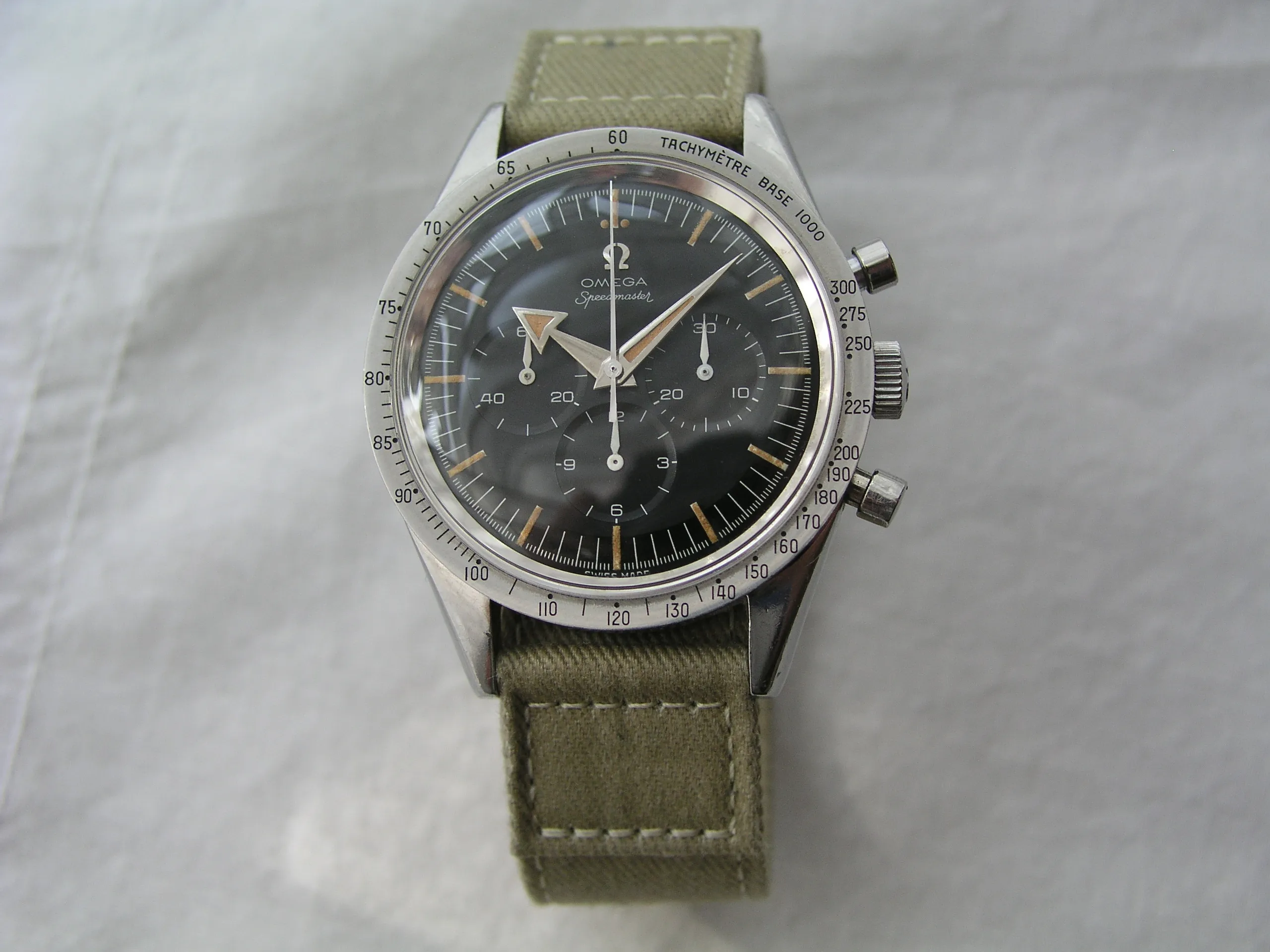
An early CK 2915, with the Broad Arrow hour hand and the tachymeter scale on the bezel. Photo: Wikimedia Commons, CC BY 2.5
How it got to space
The Speedmaster reached space before NASA chose it. On 3 October 1962, Wally Schirra wore his own Speedmaster on the Mercury Sigma 7 flight, six orbits of the Earth, which Omega says was nearly two and a half years before NASA qualified the watch.
That qualification came on 1 March 1965. Omega says NASA tested chronographs from four brands, and only the Speedmaster came through, cleared for all crewed missions and spacewalks. When Apollo 11 landed on 21 July 1969, a Speedmaster was part of each astronaut’s kit, and the “Moonwatch” name followed.

Buzz Aldrin in the Apollo 11 lunar module, July 1969, with a watch strapped over his sleeve. Photo: NASA
The story Omega tells with the most pride came a year later. After an oxygen tank failed on Apollo 13 in April 1970, Omega says the crew used their Speedmasters to time a 14-second engine burn that put the spacecraft on course for home. They splashed down safely on 17 April.
The 3861: the same watch with a modern movement
Since 2021, every Moonwatch has run calibre 3861. It replaced the 1861 and kept what makes the watch a Moonwatch: the same 42mm case, three subdials and manual winding, with no date and no automatic rotor. That keeps the case between 13.2mm and 13.5mm thick, depending on the crystal.
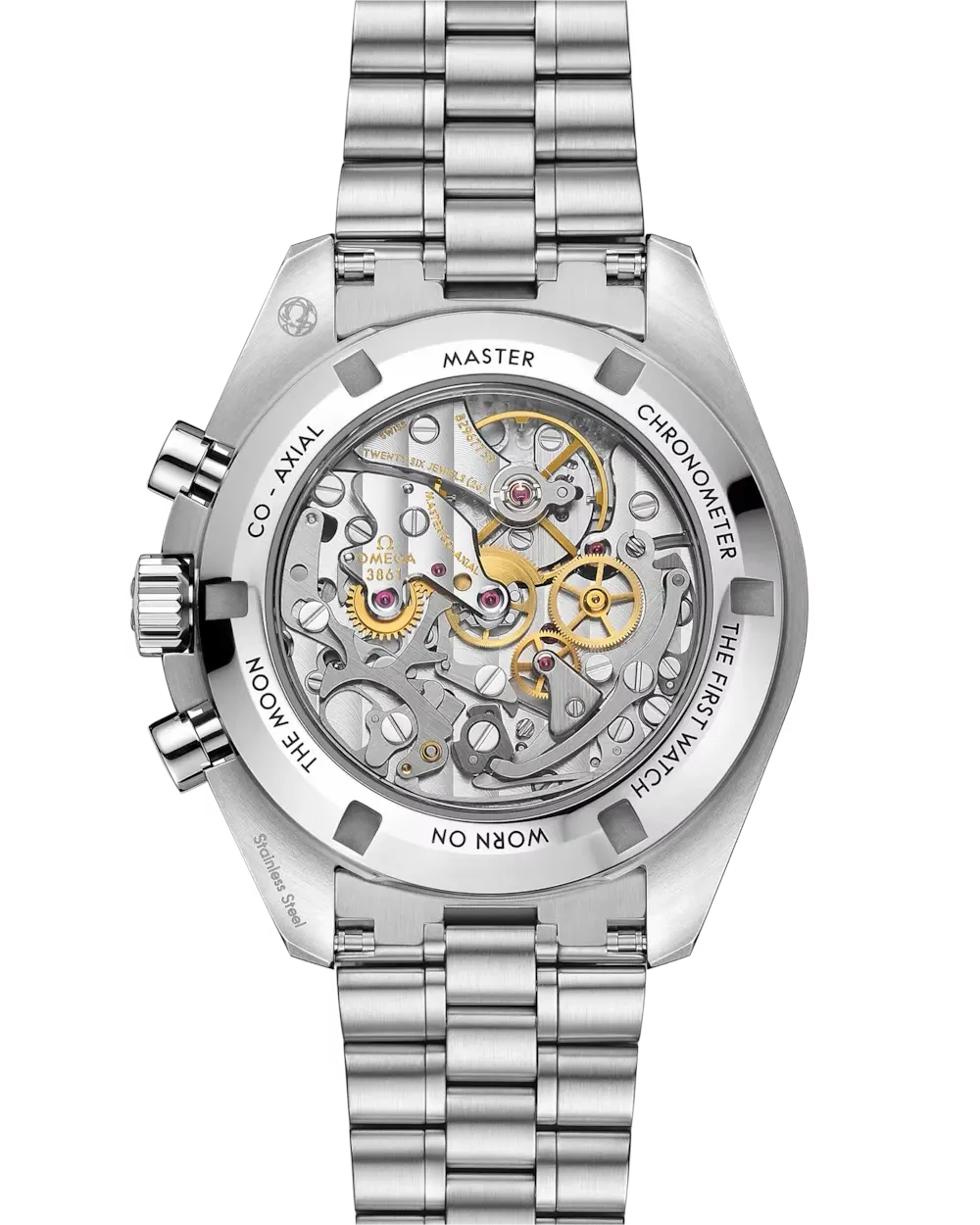
The calibre 3861 through the sapphire caseback of 310.30.42.50.01.002. Image: Omega
The new calibre brings Omega’s Co-Axial escapement and Master Chronometer certification, so it’s tested for accuracy and resists magnetic fields of 15,000 gauss. Power reserve rose from 48 to 50 hours, which means a full wind keeps it running for two days if you forget. Omega also redrew the dial’s outer track, which now splits each second into three.
What it’s like to wear
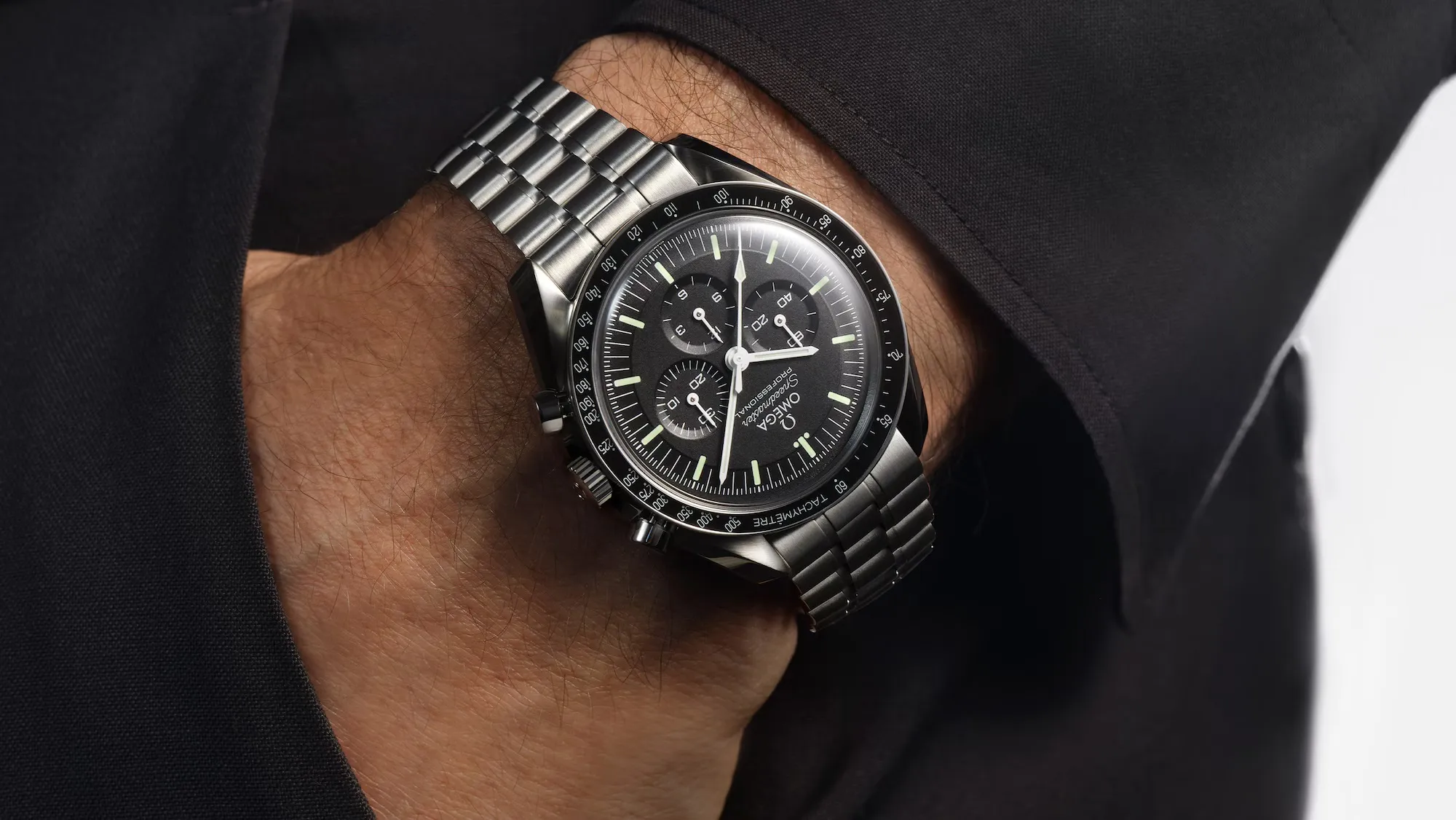
At 42mm the Moonwatch sounds big on paper, but the black dial and bezel keep it visually compact, and the case is under 14mm thick. A friend owns one, and the couple of times I’ve worn it, it slipped under a shirt cuff. The bracelet helps: Omega redesigned it in 2021, and Monochrome Watches measured it at just 15mm at the clasp, tapering from the case so it sits close on the wrist.
Winding by hand is the one habit to learn. A few turns of the crown each morning keeps it running, and if you leave it off for a weekend it’ll have stopped by Monday. Water resistance is 50 metres, which covers rain and hand-washing but not swimming, so the Moonwatch isn’t the watch for the beach.
Hesalite or sapphire
Steel Moonwatches in Australia run from $11,750, for the Hesalite model on a coated nylon strap, to $16,400, and gold versions start at $20,650 (Omega’s Australian catalogue lists them all). Most buyers end up choosing between the two models on the steel bracelet, which look nearly identical from the front and differ in the crystal, the caseback and the price.
| Hesalite (310.30.42.50.01.001) | Sapphire (310.30.42.50.01.002) | |
|---|---|---|
| Crystal | Hesalite, with an Omega logo in the centre | Domed sapphire, anti-reflective inside |
| Caseback | Solid steel, Seahorse medallion | Sapphire, shows the 3861 |
| Thickness | 13.54mm | 13.18mm |
| Price on bracelet | $12,350 | $14,175 |
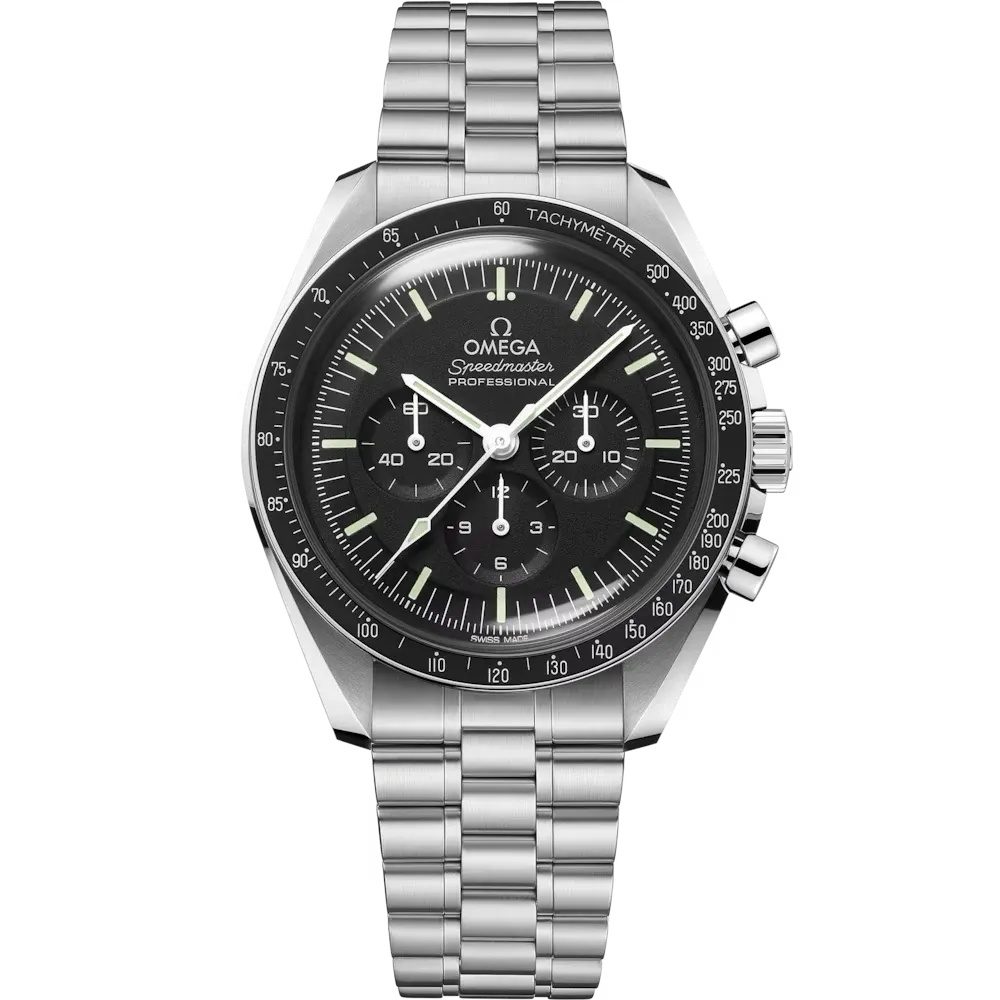
The Hesalite Moonwatch, 310.30.42.50.01.001. Image: Omega
For most people, the Hesalite model is the one to buy. It has the same crystal as the 1957 original, and the domed acrylic gives the dial a softer look than sapphire. Hesalite scratches more easily, but light marks polish out, and a deep one means a new crystal at a service. Its solid caseback carries the Seahorse and an engraving that reads “Flight-qualified by NASA in 1965 for all manned space missions”.
The sapphire model costs $1,825 more. It’s for someone who wants to see the 3861 through a glass back and never think about scratches. The trade-off is more glare from the front, since the anti-reflective coating is only on the inside, and the loss of the Seahorse caseback.
Buy from an Omega boutique (Sydney, Melbourne, Brisbane and Perth) or an authorised retailer listed on the store locator. Only then do you get Omega’s five-year warranty, which needs a certificate stamped by the seller, so a cheaper grey-market watch may not be covered.
Alternatives
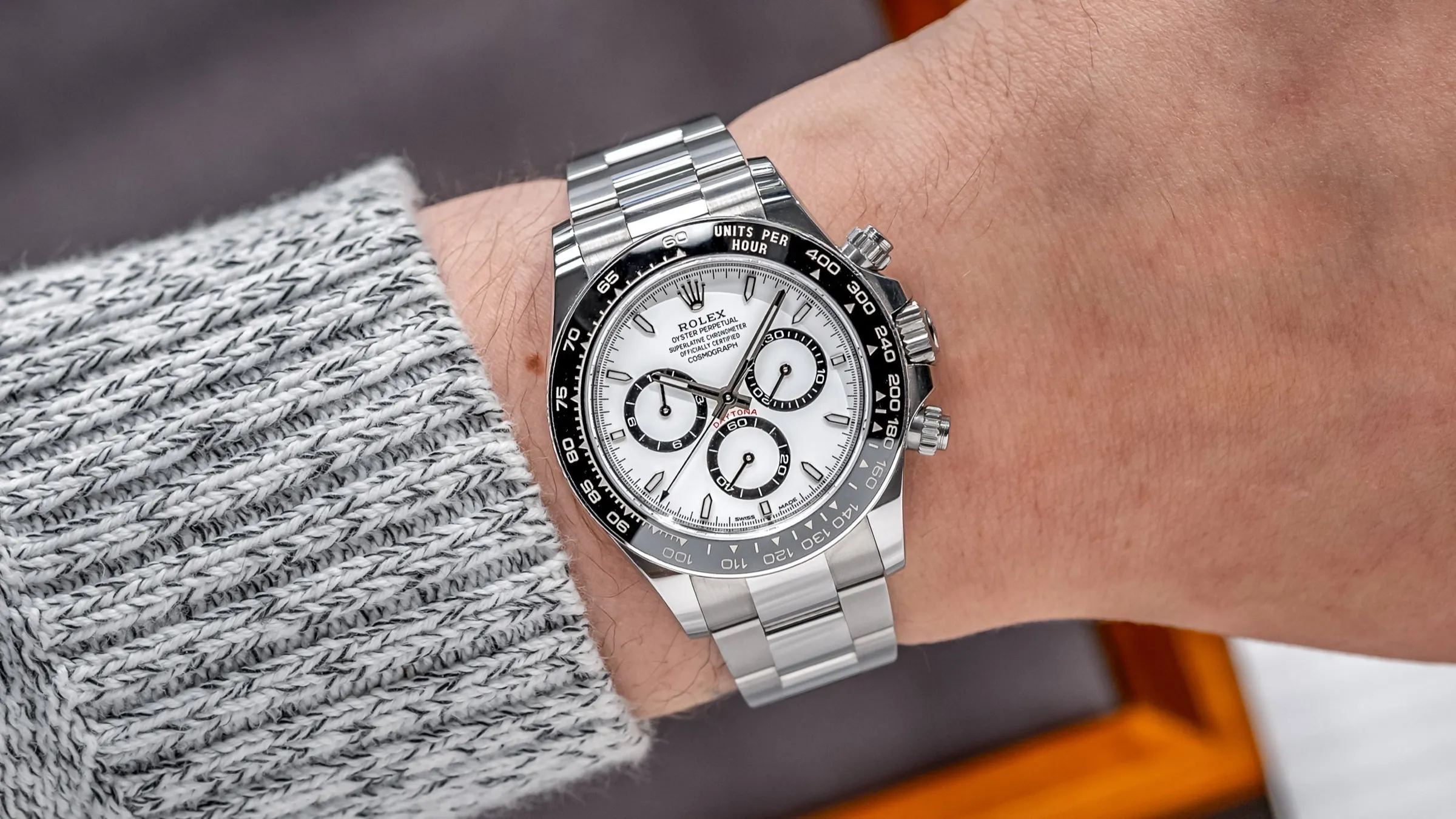
Rolex’s racing chronograph is the Daytona. It winds itself and starts at $28,200 in Australia, more than twice the price of a Moonwatch, so it suits someone who wants the racing story without the space one and has the budget.
The Speedmaster’s 1957 sibling, the Seamaster 300, is the other way into that year’s Professional line, as an automatic dive watch. For a modern Omega you can swim in and never wind, the Seamaster Diver 300M starts at $9,925.
Omega makes other Speedmasters too, including the Racing, the ’57 and the Dark Side of the Moon, but none has the Moonwatch’s history.