Rolex Oyster Perpetual: The Simplest Way Into Rolex
From the 1926 Oyster case to the centenary slate dial: every size with Australian prices, and when the Datejust or Explorer is the better buy.
In 1926 Rolex patented a watch case that kept water out. The bezel, the case back and the winding crown all screwed down tight against the middle of the case, sealing the movement from water and dust, and Hans Wilsdorf named it the Oyster because, like the shellfish, it could sit under water without harm. Five years later Rolex added a self-winding rotor it called the Perpetual. Put the two together and you have the two words Rolex still puts on its dials: Oyster Perpetual.
The watch that carries only that name is the purest form of the idea: a waterproof steel case, a self-winding movement, three hands and nothing else. It’s Rolex’s simplest watch and the cheapest new steel one, from $10,300 for the 28 mm and $11,750 for the 41 mm, and it suits anyone who wants a Rolex for every day without a date, a dive bezel or a second time zone. If you’re still deciding between models, start with our guide to the best Rolex watches.
1926: a case that kept the water out
Dust and moisture are what wear out a watch movement. Rolex’s answer was to stop treating the case as a cover and make it a seal, with every opening screwed shut. It’s the same principle in the Oyster Perpetual today, now with a screw-down case back fluted round its edge and a Twinlock crown, rated to 100 metres.
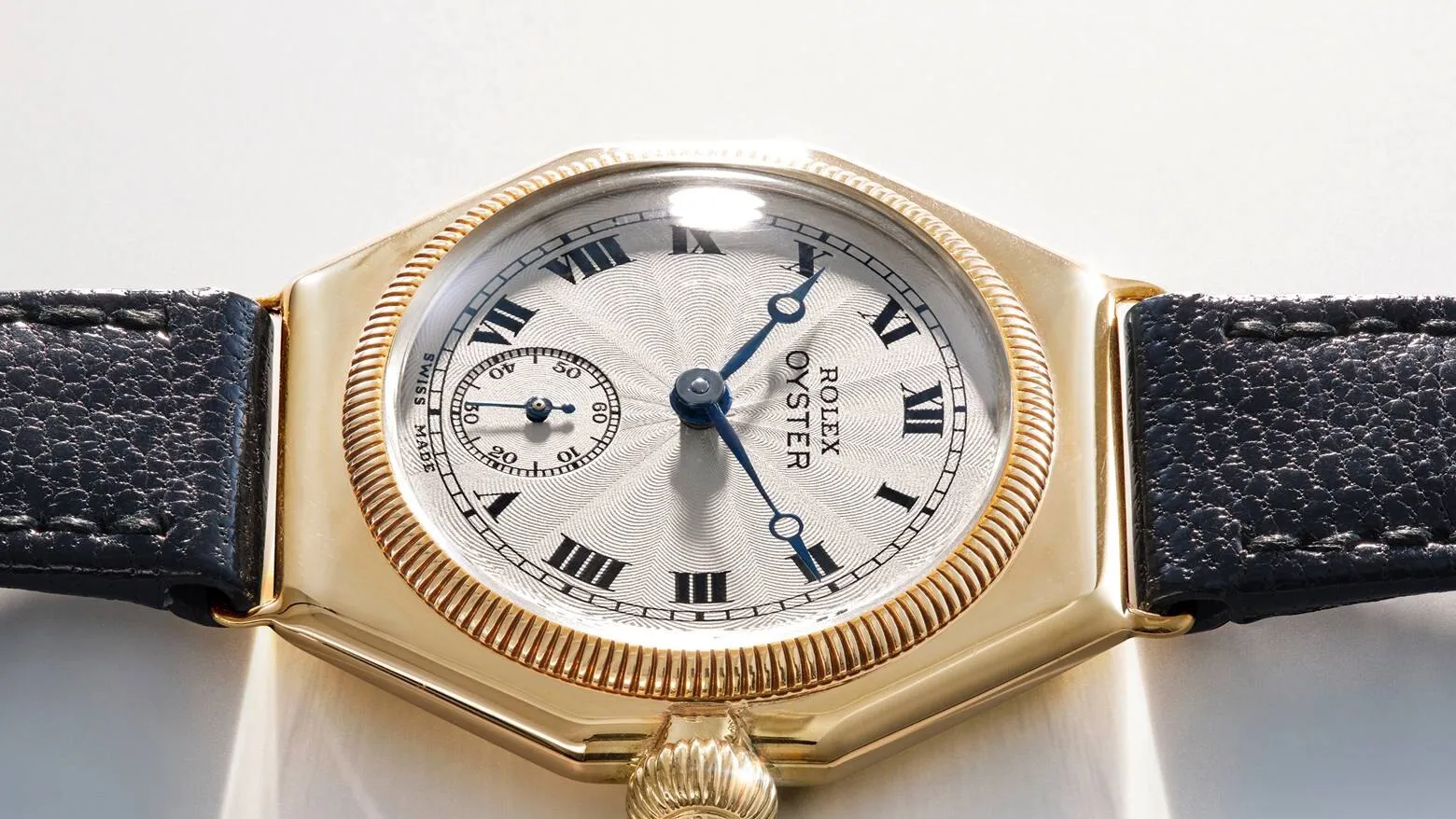
The first Oyster, 1926: a gold octagonal case with a screw-down crown and fluted bezel. Photo: Rolex
A claim like that needed proof. In October 1927 Wilsdorf gave an Oyster to Mercedes Gleitze for her swim across the English Channel, and after more than 10 hours in cold water the watch came out working. Rolex ran the result on the front page of the Daily Mail, and the swim became the template for how the brand has sold its watches ever since: put them on people doing hard things, then tell the story. Our profile of Hans Wilsdorf tells it in full.
1931: the rotor that wound itself
Waterproofing solved one of Wilsdorf’s problems. Winding was another: a mechanical watch had to be wound by hand every day. In 1931 Rolex patented the Perpetual rotor, a half-moon weight that swings freely with every movement of the wrist and winds the mainspring as it goes, so the wearer never has to.
The first Oyster Perpetual, in yellow gold, followed in the same year, and Rolex now calls it the brand’s first self-winding waterproof chronometer wristwatch. Rolex says the name on the dial stands for both things at once, waterproofness and self-winding, and it sits in front of most of its model names: the Oyster Perpetual Submariner, the Oyster Perpetual Datejust. The plain, time-only watch got its own place in the catalogue as the Oyster Perpetual range in 1985, and Rolex still presents it as the direct descendant of the 1926 Oyster.
What the modern Oyster Perpetual keeps
The current OP 36 and 41 run on calibre 3230, the same movement as the no-date Submariner and the Explorer 40, with about 70 hours of power reserve. Take it off on Friday night and it’s still running on Monday morning. Rolex certifies each finished watch as a Superlative Chronometer, accurate to within two seconds a day either way after casing, and the 2026 centenary OP 41 carries the tougher version of that test, which adds resistance to magnetism, reliability and durability to the list. The smaller OP 28, 31 and 34 use calibre 2232, with about 55 hours of reserve. It isn’t a lesser movement, just a different one: it has a silicon hairspring Rolex calls Syloxi, where the 3230 has a blue Parachrom hairspring and Rolex’s Chronergy escapement. Both are certified to the same standard.
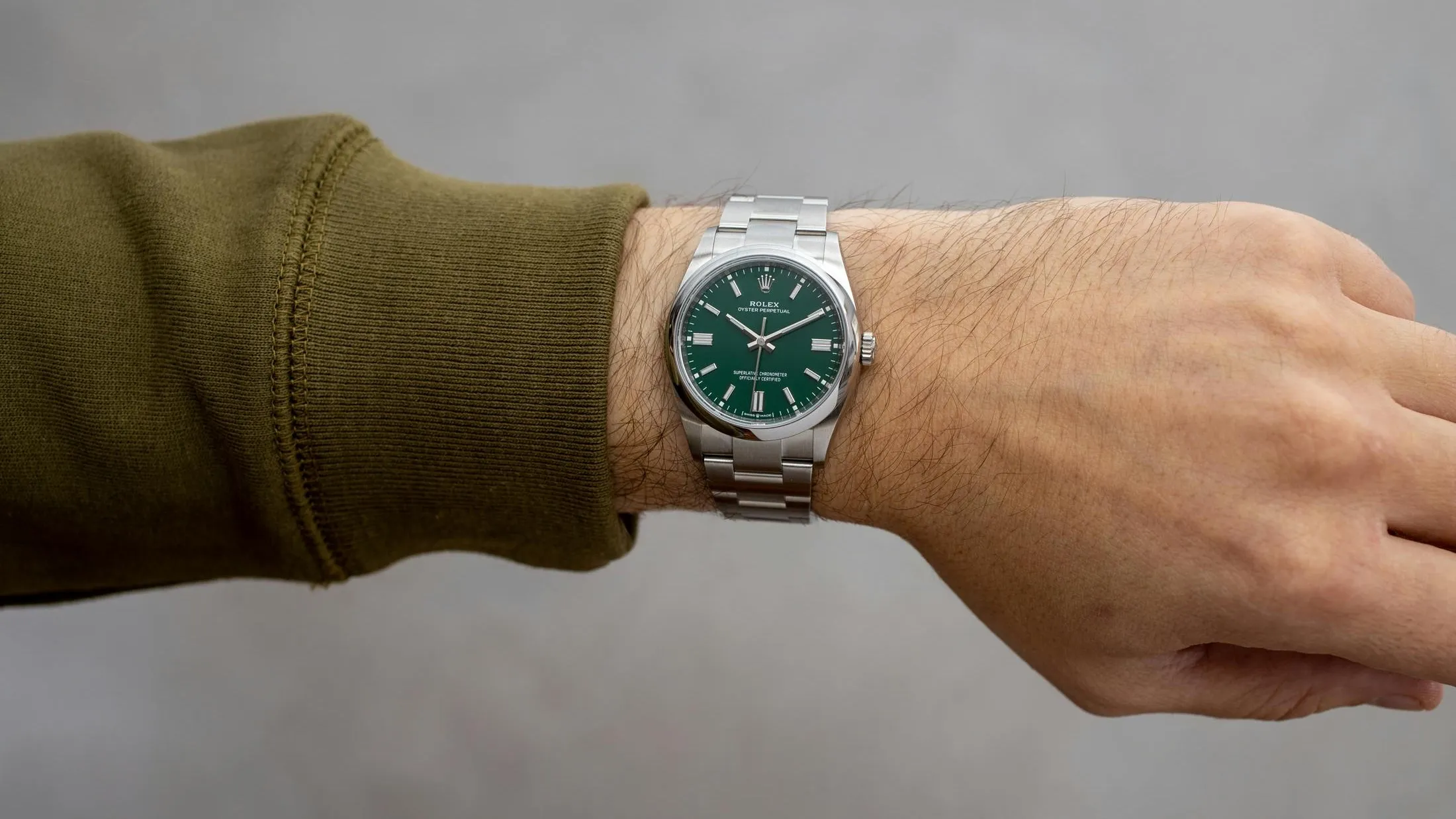
The bracelet is the Oyster, which Rolex developed in the late 1930s: three broad, slightly curved links, an Oysterclasp and an Easylink extension that lets out about 5 mm on a hot day, on every size. The bezel is domed and polished rather than fluted, and the dial shows hours, minutes and seconds with no date window. That restraint is what separates the OP from the Datejust, and it’s why the dial carries the whole look of the watch.
From pop colours to the centenary dial
In 2014 Rolex gave the OP candy pink, turquoise, yellow, coral red and green dials. The refresh that brought the OP 41 in late 2020 turned those colours into the main event: Hodinkee’s breakdown of all five sizes noted that the new OPs had collectors more excited than the new Submariner Rolex released the same year. A lacquered “Celebration” dial scattered with bubbles in all five colours followed in 2023.
Colour is now the point of the watch, and every size gets a good share of it. Candy pink, lavender, blue and black run right across the range. Pistachio comes on the 28, 36 and 41, green on the 31, 36 and 41, and only the 36 gets turquoise. Within a size, the steel colour dials all cost the same.
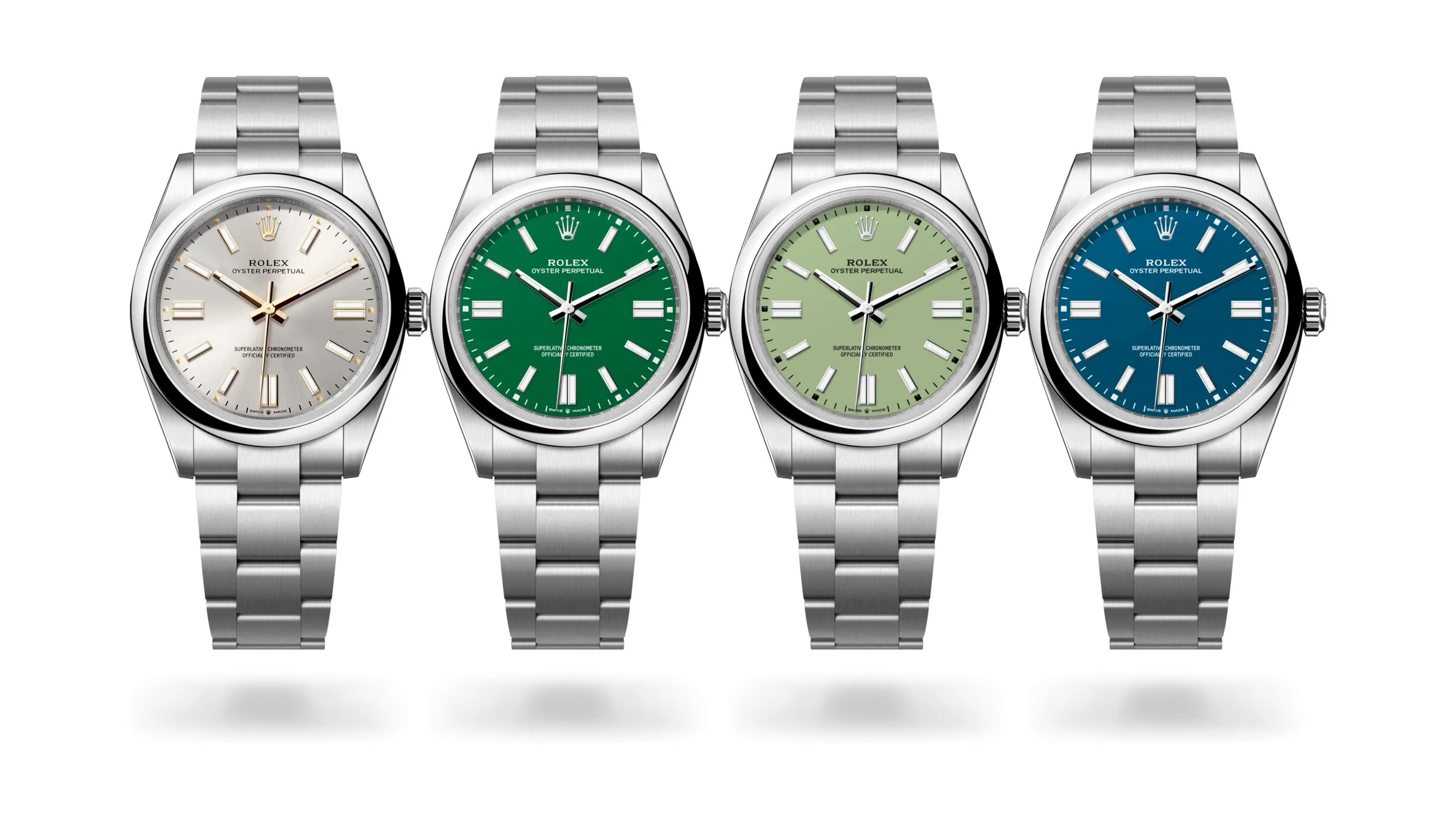
Oyster Perpetual 41 dials: silver, green, pistachio and blue. Image: Rolex
For the Oyster’s hundredth year, Rolex made a centenary OP 41 with a slate dial, a new colour for the range. “100 years” replaces “Swiss Made” at six o’clock, a 100 is raised on the crown, and green squares mark every five minutes. It pairs a yellow gold bezel and crown with an all-steel bracelet, something Rolex hadn’t done before on a two-tone watch, and costs $16,150. The 2026 OP 36 and a matching steel OP 41 revive the Jubilee motif Rolex first used at the end of the 1970s, a lacquer dial that repeats the Rolex name in ten colours. Both are the most playful OPs in the range, but the steel OP 41 remains the better value at $4,400 less than the centenary one.
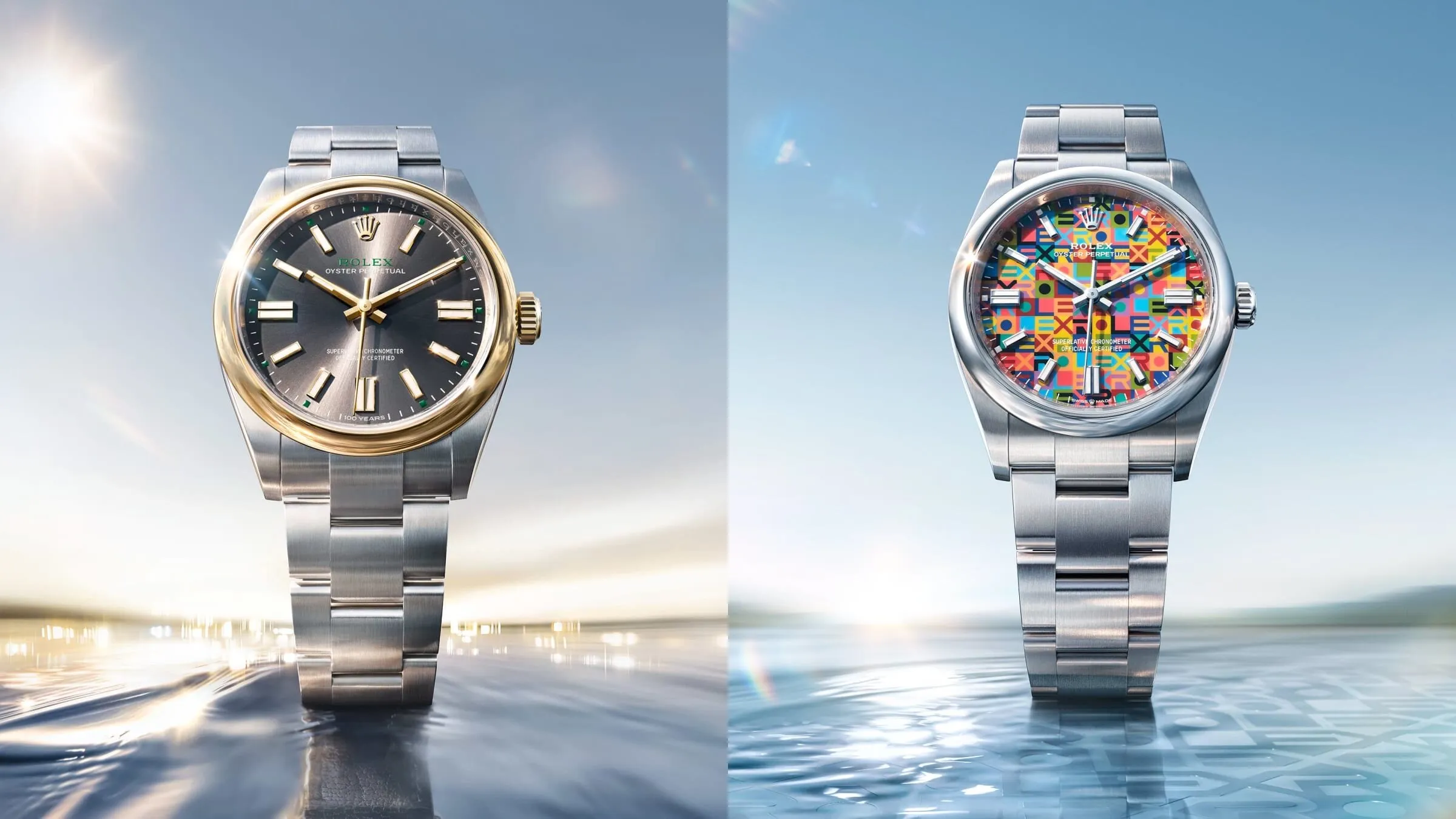
The 2026 Oyster Perpetuals: the centenary 41 with a slate dial and gold bezel, and the 36 with the multicoloured Jubilee-motif dial. Image: Rolex
Sizes and prices in Australia
Rolex makes the Oyster Perpetual in five sizes, which is unusual for the brand. In steel the prices sit close together, so size is a question of fit and look, not money. Australian RRPs from Rolex’s Oyster Perpetual range:
| Size | Reference | Calibre | Steel | Steel and yellow gold |
|---|---|---|---|---|
| 41 mm | 134300 | 3230 | $11,750 | $16,150 (134303) |
| 36 mm | 126000 | 3230 | $11,200 | $14,050 (126003) |
| 34 mm | 124200 | 2232 | $10,650 | – |
| 31 mm | 277200 | 2232 | $10,500 | – |
| 28 mm | 276200 | 2232 | $10,300 | – |
Rolex also makes the OP 28 and 34 in solid gold, the 2026 versions with hour markers cut from natural stone, from $52,950 for the 28 in yellow gold to $66,950 for the 34 in Everose. That’s a different purchase from the steel watch most people come for.
Which Oyster Perpetual to buy
For most buyers the choice is the steel OP 36 at $11,200 or the OP 41 at $11,750, picked on wrist size rather than budget. The 36 suits slimmer wrists and sits neatly under a shirt cuff. The 41 has the same movement and finish in a broader case, and reads as a modern sports watch on a bigger wrist. With only $550 between them, try both on, or look at Hodinkee’s side-by-side photos in its breakdown of the sizes first. Rolex lists the 34, 31 and 28 as women’s watches, but Hodinkee calls the 34 about as unisex as a watch gets, and it’s the one to try if the 36 feels big on you. All three have the 2232 movement and its shorter reserve.
The Datejust is the watch most buyers weigh the OP against. It adds a date window under a Cyclops magnifier, runs on calibre 3235 (the date version of the same movement) and opens up options the OP doesn’t offer: a fluted bezel, the five-piece Jubilee bracelet and more two-tone and gold combinations. In steel that costs $2,500 more at 36 mm ($13,700 against $11,200) and $3,150 more at 41 mm ($14,900 against $11,750). Choose the OP if you never look at the date, or if you want a coloured dial on a plain steel watch. Choose the Datejust if it’s going to be your one watch with a suit as well as a T-shirt, or if a fluted bezel and Jubilee bracelet are what you picture when you think of a Rolex.
The Explorer is the other plain, time-only Rolex. It shares the OP’s 3230 movement and 100-metre rating, but the Explorer 40 comes with a black dial and has the look of an expedition watch rather than a colourful everyday one. It costs more: $13,250 for the Explorer 36 and $14,050 for the Explorer 40. If you want a dial colour, the OP is the better buy. If you want a black-dial steel Rolex that isn’t a diver, the Explorer is worth the extra.
New Rolex watches are sold only through official retailers, which the Rolex retailer locator lists in each capital city, and each comes with a five-year international guarantee.